
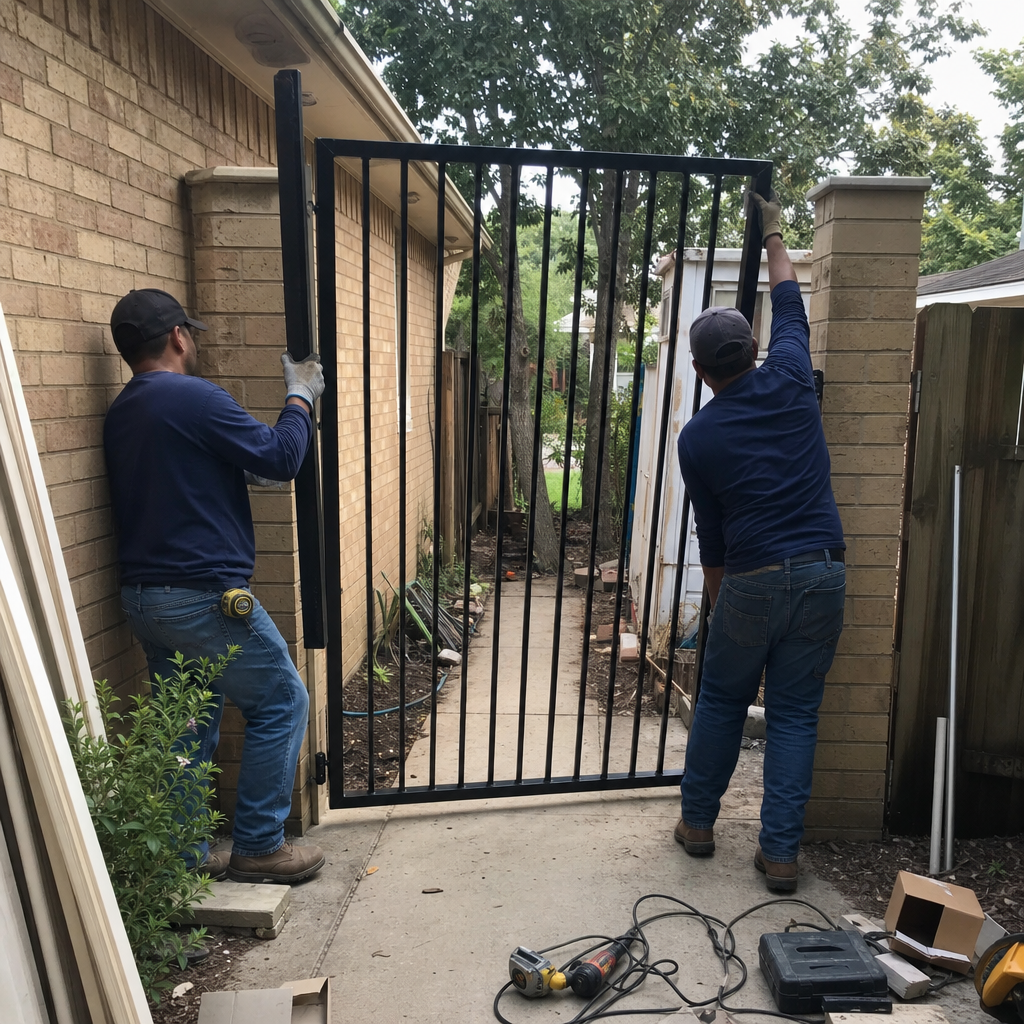
Last updated July 6, 2026
DIY vs Professional Gate Repair: The Houston Homeowner’s Decision Guide
UL 325 exists because automated gates have killed people. That safety standard — governing every gate operator sold in the United States since 2000 — was written in response to documented entrapment deaths, and the force-limiting sensors it mandates are precisely what most DIY repairs accidentally disable or miscalibrate. In Houston, where clay soil shifts, summer heat warps metal, and homeowners face a constant stream of YouTube tutorials promising easy fixes, we’ve seen too many “simple” repairs turn into $2,400 replacement jobs or worse. This guide will show you exactly which gate repairs are genuinely safe to handle yourself, which ones carry hidden liability and warranty stakes, and how to tell the difference before you pick up a wrench.
Quick Answer
Manual gate repairs — hinge lubrication, latch adjustments, debris clearing, and remote battery swaps — are genuinely DIY-friendly for most Houston homeowners. Any repair touching the automated operator system — electrical connections, limit switches, entrapment force calibration, or control board work — should be handled by a professional due to UL 325 safety requirements, warranty voiding, and liability exposure. The dividing line isn’t your skill level; it’s whether the repair involves 120V or 24V automation components.
Table of Contents
- What Makes Gate Repair Different From Other Home Projects
- DIY-Safe Repairs: The Complete List
- Never DIY: High-Risk Repairs and Why
- The Warranty Void Reality: What OEMs Actually Say
- The Tools and Knowledge Gap YouTube Doesn’t Show
- Houston-Specific DIY Risks: Heat, Clay Soil, and Code
- DIY vs. Pro: Real Cost Comparison
- The Decision Tree: Choose Your Repair Path
What Makes Gate Repair Different From Other Home Projects
Gate repair sits in a unique category between home maintenance and light industrial work. Unlike painting a room or fixing a leaky faucet, automated gates combine mechanical, electrical, and safety-critical systems under a single federal safety standard. That standard — UL 325 — creates obligations that don’t exist for most residential DIY projects.
Here’s what separates gate work from typical homeowner repairs:
- Federal safety compliance: Every automated gate operator manufactured after 2000 must include anti-entrapment devices, and these must be tested and calibrated to specification. A miscalibrated force setting can crush a child or pet — and the homeowner assumes liability.
- High-voltage exposure: Gate operators run on 120V AC power with 24V DC control circuits. The combination creates electrocution risk and fire hazard if wiring is improperly handled.
- Warranty complexity: Major brands like LiftMaster, FAAC, and Viking attach specific installation and repair conditions to their warranties. Unauthorized work can void coverage on a $1,800 operator with one misplaced wire.
- Structural load: A typical residential swing gate weighs 200–600 pounds. Improper hinge or post repair can cause catastrophic failure — property damage, injury, or worse.
We’ve spent 20 years in this trade, and the pattern is consistent: homeowners who understand these distinctions make better decisions, save money, and avoid the emergency calls that come at 10 PM when a gate won’t close and the property is unsecured.
DIY-Safe Repairs: The Complete List
Not all gate work requires a professional. These repairs carry no electrical risk, no warranty implications, and minimal liability exposure. If you’re comfortable with basic hand tools, these are genuinely within reach.
1. Hinge and Hardware Maintenance
Gate hinges seize from Houston’s combination of humidity, pollen, and occasional flooding. Annual lubrication with a lithium-based grease — not WD-40, which attracts debris — prevents most hinge failures. Check for cracked hinge pins, especially on older wrought iron gates in neighborhoods like The Heights or Montrose where original hardware may date to the 1980s.
2. Remote and Keypad Battery Replacement
Dead batteries cause more “broken gate” calls than actual mechanical failures. Most remotes use CR2032 lithium cells; wireless keypads typically run on AA batteries. Replace annually as preventive maintenance.
3. Debris Clearing and Track Cleaning
Sliding gates accumulate leaves, gravel, and construction debris in their tracks. A shop vacuum and stiff brush resolve most binding issues. For Houston properties near new development — common in areas like Cypress and Katy — construction dust is a recurring problem that monthly cleaning prevents.
4. Manual Latch and Strike Plate Adjustment
Wooden gates swell and contract with humidity, causing latches to miss strikes. A cordless drill and file are sufficient for minor repositioning. Mark the original position before moving anything.
5. Visual Inspection Routine
Monthly visual checks catch problems before they escalate. Look for:
- Rust formation at weld points or base plates
- Loose bolts on gate brackets or operator mounting arms
- Frayed cables on vertical lift or barrier arm systems
- Standing water near control boxes or conduit entries
- Unusual sounds during operation — grinding, clicking, or straining
Document what you find. If a problem persists beyond these basic interventions, you’ve reached the boundary of DIY territory.
Never DIY: High-Risk Repairs and Why
These repairs touch systems where error carries consequences beyond the immediate fix. We’ve responded to Houston homes where well-intentioned DIY work created hazards that didn’t exist before the homeowner started.
Limit Switch and Travel Adjustment
Gate operators use magnetic or mechanical limit switches to determine open and close positions. Misadjustment causes the gate to over-travel — crushing vehicles, hitting structures, or stressing the operator motor. Worse, some homeowners “fix” binding by extending travel distance rather than addressing the root cause, masking a mechanical problem until catastrophic failure.
Entrapment Force Calibration
UL 325 mandates that gates reverse when encountering specified resistance — typically 40 pounds of force for residential systems. This requires a force gauge and manufacturer-specific procedure to verify. We’ve found DIY “adjustments” that set force to 80+ pounds or disable reversal entirely. In Houston’s litigious environment, that’s exposure no homeowner should carry.
Electrical Connections and Control Board Work
Control boards manage low-voltage logic, high-voltage power, and safety device inputs. Incorrect wiring can fry a $400 board, create fire risk, or energize gate surfaces. Capacitors on operator motors retain lethal charge even when unplugged.
Spring and Torsion Component Replacement
Some vertical lift and overhead gate systems use high-tension springs. These store enough energy to cause serious injury or death if released improperly. Never attempt spring replacement without proper winding bars and training. James Wilson has handled this personally for 20 years, and spring work remains the repair we most strongly recommend leaving to trained technicians.
Structural Welding and Post Repair
Gate posts in Houston’s gumbo clay bear enormous loads. When soil movement causes leaning, the instinct is to push the post upright and weld a brace. Without understanding load vectors and proper embedment depth, this creates a failure point that collapses under stress. We stock parts and weld on-site, but we also know when a post needs full replacement rather than cosmetic reinforcement.
The Warranty Void Reality: What OEMs Actually Say
Manufacturer warranties on gate operators contain specific language about unauthorized repair. Understanding this language matters when you’re deciding whether to open that control box.
LiftMaster: Warranty documentation specifies that “damage caused by improper installation, repair, or maintenance” voids coverage. The company maintains a network of certified dealers and tracks serial numbers against installation records. A DIY control board replacement on a LiftMaster LA500 — a common Houston residential swing operator — eliminates the 5-year motor warranty if subsequent motor failure occurs.
FAAC: Italian-built FAAC systems, popular in upscale Houston communities like River Oaks and Tanglewood, require dealer registration for warranty activation. The 770 model swing gate operator carries a 2-year parts warranty that’s explicitly conditional on “installation and service by authorized FAAC technicians.”
Viking: Viking’s residential warranty states that “modifications or repairs not performed by Viking or an authorized representative” void all coverage. Their commercial warranties are even more restrictive, requiring documented service history.
Here’s what this means practically: a $180 DIY control board swap that fails can leave you with a $1,400 operator replacement that would have been fully warrantied. The math shifts quickly against DIY when warranty exposure enters the calculation.
At Horizon Gate Repair Service Texas home, we service your brand — including Linear, Viking, Ghost Controls, and DoorKing — with the manufacturer familiarity that preserves warranty coverage and gets the diagnosis right the first time.
The Tools and Knowledge Gap YouTube Doesn’t Show
DIY gate repair tutorials consistently skip the prerequisites. Here’s what you actually need versus what most videos assume.
| Task | YouTube Assumes You Have | What You Actually Need |
|---|---|---|
| Operator diagnostics | Basic multimeter | True-RMS multimeter, manufacturer diagnostic manual, understanding of 24V DC logic vs. 120V AC power circuits |
| Limit switch adjustment | Screwdriver | Manufacturer-specific adjustment tool or software, understanding of encoder vs. mechanical limit systems |
| Force calibration | “Feel” for proper resistance | Certified force gauge, knowledge of UL 325 thresholds, documentation of test results for liability |
| Control board replacement | Wire-for-wire swap | ESD-safe work environment, understanding of dip switch or software configuration for your specific gate length and weight |
| Post/structural repair | Welding machine | Structural welding certification for load-bearing applications, concrete embedment knowledge, soil load analysis |
The gap between assumption and reality explains why our Houston emergency calls spike on weekends — when homeowners have time to attempt repairs and discover the tutorial omitted critical steps. James Wilson has handled this personally for 20 years, and the pattern is predictable: Monday mornings bring calls from Friday’s “quick fix.”
Houston-Specific DIY Risks: Heat, Clay Soil, and Code
Houston’s environment creates gate repair challenges that don’t exist in other markets. These factors complicate DIY diagnosis and increase the cost of error.
Summer Heat and Metal Temperature
From June through September, Houston gate systems routinely reach surface temperatures of 130–150°F. This isn’t discomfort — it’s a functional problem. Thermal expansion changes gate geometry, causing binding that disappears in cooler months. We’ve seen homeowners grind hinges, reposition latches, and bend tracks to address “misalignment” that’s actually temperature-related dimensional change. The proper fix involves material selection and installation tolerances designed for Houston’s thermal range, not force-fitting components in July.
Working on hot metal creates additional injury risk. Welded joints, operator housings, and dark powder-coated surfaces retain heat hours after sun exposure. We’ve treated contact burns that occurred during what should have been simple bolt tightening.
Clay Soil Movement
Houston’s gumbo clay expands and contracts dramatically with moisture changes. A gate that operated perfectly in April may bind in August after soil shrinkage shifts post alignment. The DIY instinct is to adjust the gate; the correct diagnosis often involves understanding soil movement patterns and designing post embedment to accommodate them.
In neighborhoods like Meyerland or Bellaire, where flooding has become more frequent, we’ve documented post movement of 2–3 inches in single storm events. Adjusting a gate to compensate for this movement guarantees problems when soil rehydrates and posts return toward original position.
Electrical Code and Flood Exposure
Houston’s position in FEMA flood zones affects electrical installation requirements. NEC Article 547 and local amendments specify elevation and enclosure standards for outdoor electrical equipment. Post-Harvey, many Houston jurisdictions enforce these requirements more strictly. DIY electrical work that doesn’t account for flood exposure creates code violations that complicate insurance claims and property sales.
Pollen and Humidity Corrosion
Houston’s year-round humidity and intense spring pollen create corrosion conditions that accelerate contact failure in control boards and safety devices. Cleaning a corroded contact seems simple; diagnosing whether corrosion indicates a systemic moisture intrusion problem requires understanding enclosure ratings and conduit sealing. We’ve replaced too many “fixed” boards that failed again within months because the root cause — a compromised NEMA enclosure or missing gasket — went unaddressed.
DIY vs. Pro: Real Cost Comparison
Cost decisions require honest accounting of parts, tools, time, and risk. Here’s how actual scenarios compare for Houston homeowners.
Scenario 1: Remote Programming Failure
DIY path: Replacement remote ($35–$65), programming time (30–60 minutes for first attempt), potential for incorrect programming that locks out all remotes. Total: $35–$65 plus time.
Professional path: Service call with diagnostic ($150–$225), includes verification of receiver function and battery status, reprogramming of all remotes. Total: $150–$225.
Verdict: Genuine DIY opportunity if you have manufacturer programming instructions and patience for the learn-button sequence.
Scenario 2: Gate Binds Mid-Travel
DIY path: Hinge lubrication ($12), track cleaning (1 hour), possible hinge replacement ($45–$80), possible post adjustment (requires tools most homeowners lack). If misdiagnosed as hinge problem when actual cause is operator force decay: wasted parts, persistent problem, eventual operator damage. Total: $57–$92 minimum; $400+ if operator damaged.
Professional path: Diagnostic service ($150–$225), accurate identification of root cause, repair with warranty. Total: $150–$400 depending on actual problem.
Verdict: Professional diagnostic pays for itself; binding has multiple causes with similar symptoms.
Scenario 3: Operator Runs But Gate Doesn’t Move
DIY path: Possible causes include stripped drive gear ($180–$340 part), broken chain/belt ($65–$145), seized operator arm ($220–$380 replacement), or control board output failure ($280–$450). Without diagnostic capability, you’re guessing with expensive parts. Wrong guess voids return policy on electronic components. Total: $65–$450 per guess; multiple guesses common.
Professional path: Diagnostic identifies exact failure, repair uses correct part with installation warranty. Total: $280–$580 typical.
Verdict: Professional repair almost always costs less than sequential DIY guesses.
Scenario 4: Safety Sensors Malfunctioning
DIY path: Replacement photocells ($45–$85), possible wiring repair ($25–$45 materials), possible control board issue ($280–$450). UL 325 requires documented testing after repair; most homeowners lack equipment. If entrapment occurs after DIY repair, liability exposure is uninsured. Total: $70–$535 plus unquantified liability.
Professional path: Complete diagnostic, UL 325-compliant repair, documented force and safety testing, liability transfer to licensed provider. Total: $225–$485.
Verdict: Professional repair is lower cost when liability and testing requirements are honestly included.
When calling a pro saves money vs. costs more: the break-even point typically falls at repairs involving electrical diagnosis, warranty-covered components, or safety-critical systems. One call covers it — and with 638 customers and counting, our track record shows where that call delivers value.
The Decision Tree: Choose Your Repair Path
Use this flowchart to make the DIY vs. professional decision before you start.
- Does the repair require opening the operator control box?
- Yes → Professional recommended. Electrical exposure and warranty implications.
- No → Continue to question 2.
- Does the repair involve adjusting how far or how hard the gate moves?
- Yes → Professional required. UL 325 entrapment protection at stake.
- No → Continue to question 3.
- Does the repair involve welding, cutting, or structural modification?
- Yes → Professional recommended. Load-bearing safety and code compliance.
- No → Continue to question 4.
- Is the gate under manufacturer warranty (typically under 2–5 years)?
- Yes → Professional required to preserve coverage.
- No → Continue to question 5.
- Do you have the specific tools and manufacturer documentation for this repair?
- No → Professional recommended. Generic tools cause generic mistakes.
- Yes → Continue to question 6.
- Can you complete the repair in under 2 hours with confidence?
- No → Professional likely more cost-effective. Your time has value; weekend repairs that stretch into multi-day projects carry frustration costs and security exposure.
- Yes → Genuine DIY candidate. Proceed with manufacturer documentation and appropriate safety equipment.
At Gate Repair in North Richland Hills, we apply this same diagnostic discipline — matching the right response to the actual problem, not defaulting to replacement or upsell.
Common Mistakes to Avoid
- Ignoring the root cause: Houston homeowners often adjust gate travel to compensate for binding rather than fixing the actual problem — worn hinges, shifted posts, or damaged rollers. This masks the issue until operator failure or structural damage occurs.
- Using incorrect lubricants: WD-40 and similar penetrating oils attract dust and harden in Houston humidity. Use lithium-based grease on mechanical components and silicone spray on weather seals.
- Disconnecting safety devices to “fix” sensor problems: Bypassing photocells or edge sensors creates immediate UL 325 non-compliance and lethal entrapment risk. We’ve responded to Houston properties where this “temporary” bypass became permanent.
- Working on hot metal without temperature awareness: Summer gate surfaces in Houston can cause second-degree contact burns. Schedule physical work for morning hours, and test surfaces before prolonged contact.
- Assuming all operators use the same logic: A procedure that works on a Mighty Mule system may damage a FAAC or Viking controller. Always verify manufacturer-specific instructions before attempting any operator interaction.
- Neglecting to document pre-repair condition: Photos of wiring, dip switch positions, and mechanical settings before disassembly prevent catastrophic reassembly errors. This step takes 5 minutes and saves hours of troubleshooting.
- Underestimating flood damage: Houston’s flooding history means water exposure should always trigger professional inspection. Moisture in control boxes can cause delayed failure, and corrosion continues spreading after visible drying.
When to Call a Professional
Call a qualified gate technician when your repair involves electrical components, safety systems, warranty coverage, structural loads, or any situation where error carries injury or liability risk. In Houston’s climate and regulatory environment, professional repair typically costs less than the combined expense of parts, time, and potential consequences of DIY mistakes.
Horizon Gate Repair Service Texas offers free estimates in Houston — call (855) 301-3214. James Wilson serves as lead technician on every job, bringing 20 years of direct experience with the brands, systems, and local conditions that determine whether a repair lasts or fails. We service your brand, we stock parts and weld on-site, and we document every safety test to UL 325 standard.
For installation needs beyond repair, see our Gate Installation in North Richland Hills services, or explore Gate Motor & Opener in North Richland Hills for operator-specific expertise.
Frequently Asked Questions
No — most major brands including LiftMaster, FAAC, and Viking explicitly void warranties for unauthorized repair or modification. Warranty terms require service by authorized technicians, and manufacturers track serial numbers against dealer installation records. If your operator is under warranty, professional service is the only path that preserves coverage. Call (855) 301-3214 for warranty-compliant repair — estimates are free.
Professional gate repair in Houston typically ranges from $150 for basic diagnostic and adjustment to $580 for complex operator repair, with most residential repairs falling between $225 and $400. DIY parts costs often appear lower but exclude tools, time, and the expense of incorrect diagnosis — which we’ve seen turn $80 in parts into $1,400 in replacement costs. When liability exposure and warranty preservation are included, professional repair is usually the lower total cost for any electrical or safety-related work.
Thermal expansion from Houston’s summer heat changes gate geometry, particularly on dark-colored metal gates and long spans. A gate that measures true at 70°F may grow 1/4 to 1/2 inch at 140°F surface temperature, enough to cause binding in tight-tolerance installations. The fix involves installation tolerances designed for Houston’s thermal range, not force-fitting components seasonally. James Wilson has handled this personally for 20 years — it’s a material science problem, not a simple adjustment.
No — entrapment force adjustment requires a certified force gauge and manufacturer-specific procedure under UL 325. Improper adjustment can cause crushing injury or death, and creates uninsured liability exposure. Houston’s legal environment makes this particularly risky; a single incident can exceed homeowner policy limits. This repair should never be attempted without proper training and equipment.
Listen and observe: mechanical problems typically produce visible wear, unusual sounds (grinding, squealing, clicking), or physical resistance you can feel by pushing the gate manually. Electrical problems often show as intermittent operation, failure to respond to commands, or erratic movement without physical binding. When in doubt, assume electrical — misdiagnosing an electrical problem as mechanical can damage components and create safety hazards. Professional diagnostic protects against this error.
Houston’s gumbo clay absolutely damages gates — it’s documented engineering reality, not sales pressure. Clay expands up to 10% when saturated and shrinks dramatically during drought, exerting forces that shift posts, crack concrete, and misalign tracks. In flood-prone areas like Meyerland, Braeswood, or near Buffalo Bayou, we’ve measured post movement of several inches in single events. Proper post embedment depth, drainage design, and material selection are genuine technical requirements for Houston gate longevity, not optional upgrades.
The Bottom Line
The DIY vs. professional decision for gate repair isn’t about your competence with tools — it’s about system boundaries. Manual hardware maintenance, cleaning, and battery replacement are genuinely within reach for most Houston homeowners. Any repair crossing into automated operator systems carries federal safety requirements, warranty conditions, and liability stakes that shift the math decisively toward professional service. In Houston’s punishing heat, shifting clay soil, and flood-exposed environment, even seemingly simple problems often have root causes that DIY approaches miss. Know the line, respect the risks, and when uncertainty exists, get a professional diagnostic before the small problem becomes the expensive emergency.
Written by James Wilson, Owner & Lead Technician at Horizon Gate Repair Service Texas, serving Houston since 2006.