Last updated July 6, 2026
Gate Repair Warning Signs: A Houston Homeowner’s Reference Guide
A gate that hesitates for two seconds before opening isn’t “just getting old” — in most cases it’s a dying capacitor, a misaligned limit switch, or a chain with stretch, all of which cost under $150 to fix if caught before they cascade into motor failure or structural damage. After 20 years of opening operator boxes across Houston, from Memorial to Third Ward to the Woodlands, we’ve learned that local warning signs look different from what national guides describe. Our gumbo clay soil, 90% summer humidity, and spring storm cycles produce failure patterns that only show up in this climate — and catching them early is the difference between a $200 service call and a $1,800 replacement. This guide walks through the specific mechanical, structural, and electrical warning signs Houston homeowners should watch for, plus the simple monthly check that catches 80% of developing problems before they become emergency repairs.
Quick Answer
The five critical gate repair warning signs Houston homeowners should never ignore are: hesitation on start (usually capacitor or limit switch failure), grinding noise on reversal (chain stretch or worn gears), visible post lean (soil heave or foundation settlement), rust bloom at hinge welds (humidity-driven corrosion), and erratic remote response (failing receiver or antenna damage). A monthly 60-second visual inspection — checking latch gap consistency, listening for startup sounds, and noting any new scraping — catches most of these before they cascade into motor failure or structural collapse.
Table of Contents
- The Five Mechanical Warning Signs Houston Homeowners Consistently Ignore
- Operator Issue vs. Structural Issue: How to Tell the Difference
- Houston-Specific Signs: What Soil Heave Looks Like from Your Driveway
- Control Board Warning Signs Hidden Inside the Operator Box
- The 60-Second Monthly Check That Prevents 80% of Emergency Repairs
- What Early Warning Signs Cost to Fix vs. What They Cost to Ignore
- Common Mistakes to Avoid
- When to Call a Professional
- Frequently Asked Questions
The Five Mechanical Warning Signs Houston Homeowners Consistently Ignore
Every week in Houston, we get calls from homeowners who say their gate “was fine yesterday” — but the failure was telegraphing for months. Here are the five signs we see most often, and what each one actually means inside your system.
1. Hesitation on Start
Your gate pauses for one to three seconds after you press the remote, then jerks into motion. This isn’t normal aging — it’s one of three specific failures developing:
- Dying capacitor: The start capacitor gives your motor the initial jolt of power it needs. In Houston’s heat, capacitors degrade faster than in cooler climates. A replacement runs $85–$140, but if it fails completely, the motor draws excess current and burns out — that’s a $600–$1,200 operator replacement.
- Misaligned limit switch: The switch that tells the motor “start now” has shifted position, often from vibration or post movement. Adjustment is typically $120–$180.
- Chain or belt stretch: Slack develops before visible sagging. Catching it early means a $150–$250 adjustment or replacement; waiting means the chain jumps the sprocket and damages the motor.
In our experience across Houston neighborhoods from Bellaire to Cypress, hesitation is the most commonly ignored early warning — and the most expensive when missed.
2. Grinding on Reversal
A healthy gate reverses smoothly. Grinding during direction change means metal-on-metal contact somewhere in the drive system. Most often it’s chain stretch allowing the chain to ride the sprocket teeth incorrectly, or worn nylon gears inside the operator housing shedding material. The grinding you hear is accelerated wear — every cycle removes more material. We’ve replaced entire gearboxes in Katy and Sugar Land that could have been saved with a $200 chain adjustment six months earlier.
3. Visible Post Lean
Stand at your gate and sight along the post line. Any tilt beyond 2–3 degrees is significant. In Houston, post lean usually signals one of two problems: soil heave from our expansive clay soils (especially after wet springs like 2024), or footing degradation from poor initial concrete work. A leaning post puts lateral stress on hinges, misaligns the gate frame, and eventually prevents latching. The repair escalates from post stabilization ($400–$700) to full post replacement with proper depth and drainage ($1,200–$1,800).
4. Rust Bloom at Hinge Welds
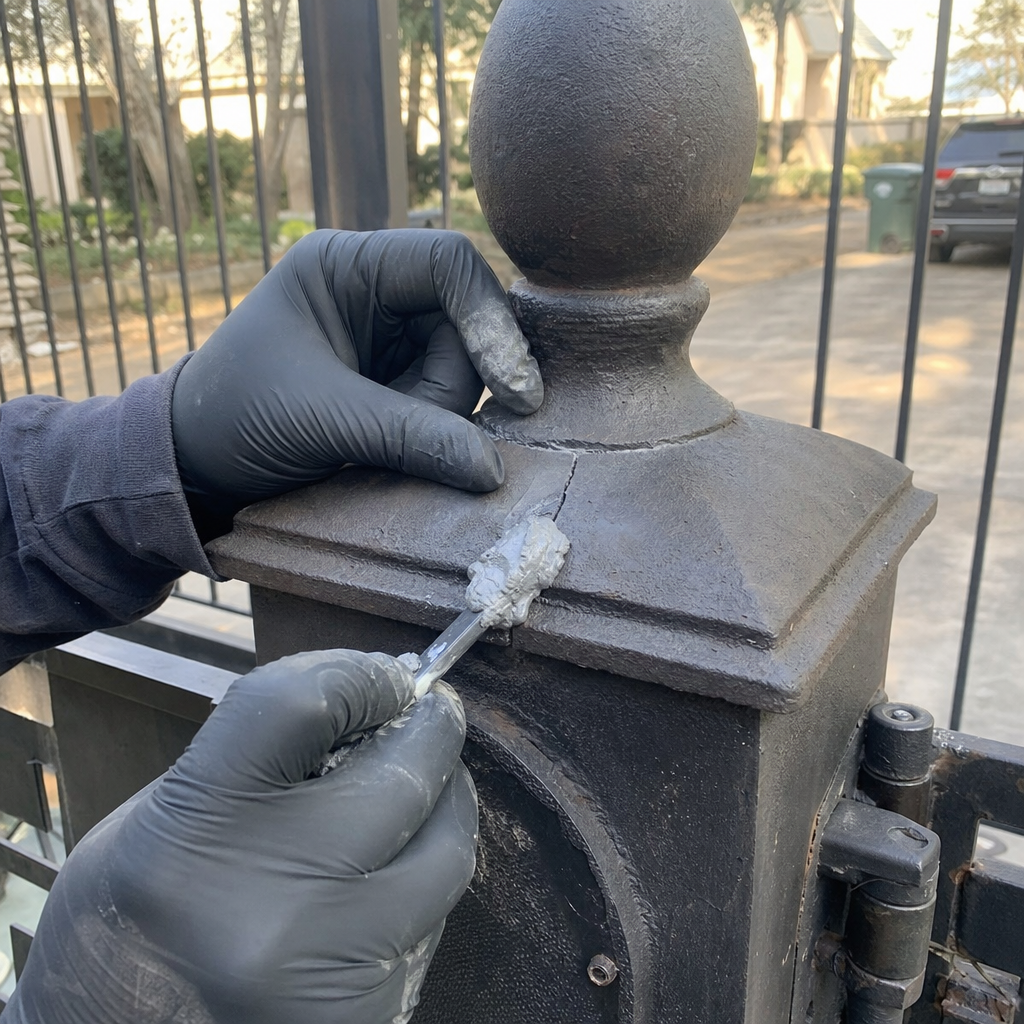
Houston’s 90% relative humidity for five months annually creates condensation inside tubular steel gate frames — even on “powder-coated” gates with compromised edges. The first visible sign is orange-brown bloom where the hinge bracket welds meet the frame. This isn’t surface rust; it’s typically interior corrosion working outward. By the time you see bloom, the weld heat-affected zone may have lost 30% of its structural integrity. We catch these early with our mobile welding capability and can re-bracket before the frame itself requires section replacement.
5. Erratic Remote Response
Intermittent operation — works from 15 feet, not from 30; works Tuesday morning, not Tuesday afternoon — usually traces to a failing receiver board or damaged antenna lead. Houston’s intense UV and summer heat degrade antenna coaxial connections faster than in milder climates. The receiver itself may be fine; often it’s a $45 antenna replacement. But homeowners who tolerate erratic response until total failure usually need the full receiver board replaced, plus reprogramming of all remotes and access codes.
Operator Issue vs. Structural Issue: How to Tell the Difference
This distinction matters because the repair path, cost, and urgency are completely different — and misdiagnosis wastes money and time.
| Symptom | Operator Issue | Structural Issue |
|---|---|---|
| Gate won’t open | Motor hums but gate doesn’t move; relay clicks heard | Gate moves freely by hand but motor doesn’t engage |
| Partial travel | Stops at same point every time; limit switch or obstruction sensor | Stops at variable points; binding or dragging changes with temperature/moisture |
| Noise pattern | Consistent mechanical noise from operator housing | Scraping or grinding that changes with gate position |
| Manual operation | Gate moves smoothly when disconnected from operator | Gate binds or resists even with operator disconnected |
| Weather response | No correlation with rain or temperature | Worse after heavy rain, better in dry periods (soil movement) |
Here’s the practical test we teach Houston homeowners: disconnect the operator arm or chain (every system has a manual release — check your LiftMaster, FAAC, or BFT manual for the specific lever location). Try moving the gate by hand. If it moves smoothly through full travel, you’ve isolated an operator issue. If it binds, scrapes, or requires force, you’ve got a structural or alignment problem.
We’ve responded to calls in the Heights where a homeowner had already paid another company to replace a “faulty” operator — but the real problem was a post settling ¾ inch after Houston’s 2021 freeze-thaw cycle, putting the gate frame in a slight twist. New operator, same binding. The correct repair was post stabilization and hinge realignment, not a $900 motor replacement.
Houston-Specific Signs: What Soil Heave Looks Like from Your Driveway
National gate repair guides don’t prepare you for Houston’s gumbo clay. Our soils expand when wet and contract when dry, moving fence and gate posts in cycles that concrete footings alone can’t always resist. Here’s what soil heave looks like from the homeowner’s perspective — and why it’s so often misread as a hinge problem.
The Gap Test
Look at the latch-side gap between your gate and the post or strike plate. Measure it, or simply note if a pencil slides through easily. Check again after a heavy rain and again after two weeks of dry weather. If that gap changes by more than ¼ inch, your post is moving with soil moisture cycles. This isn’t a hinge problem — it’s a foundation problem.
The Drag Test
Open your gate halfway and look at the bottom edge relative to the driveway or ground. In Houston’s clay soils, we commonly see gates that drag at the center of travel but clear at the ends — the post has tilted slightly, creating a low point in the arc. Homeowners often shim the hinges repeatedly, chasing the problem, when the real fix is post stabilization or a deeper footing with proper drainage.
Seasonal Patterns to Track
- Spring (March–May): Heavy rains saturate clay soils. Posts may lean or gates may bind as soil swells. Note any new scraping or latch misalignment.
- Summer (June–September): Drought conditions reverse the cycle. Gaps may open up; latches may not catch without adjustment. This is when hinge bolts loosen from vibration on now-undersupported posts.
- Fall (October–November): Often the most stable period. If your gate works perfectly now, note the gap measurements as your baseline.
- Winter (December–February): Freeze events are rare but impactful. The 2021 freeze caused more gate post heave calls in February and March than we typically see in a full year.
In neighborhoods like Meyerland and Braeswood, built on former rice paddies with particularly active clays, we’ve seen gates require seasonal adjustment twice yearly. The homeowners who track these patterns and call before binding becomes motor strain save substantially over those who wait for total failure.
Control Board Warning Signs Hidden Inside the Operator Box
Most homeowners never open their operator housing. That’s understandable — it’s a metal box with electrical components. But the control board tells stories that external symptoms only hint at, and in Houston’s climate, those stories develop faster than in drier regions.
What to Look For (Safely)
First, cut power at the breaker — never open an operator box live. With power off and the cover removed, look for:
- Swollen capacitors: The cylindrical components should have flat tops. Any doming or leaking electrolyte (brown crust at the base) means imminent failure. Houston heat accelerates this; we replace more capacitors in July and August than all other months combined.
- Corroded terminals: Green or white buildup on wire connection points indicates moisture intrusion. Our humidity creates condensation inside supposedly sealed housings, especially when temperature swings are large (hot day, cool evening).
- Burn marks or scorched traces: Darkened areas on the circuit board mean the board has already experienced overload — often from a failing component elsewhere in the system drawing excess current.
- Error code history: Most modern operators — LiftMaster, Linear, and FAAC among them — store recent fault codes. Check your manual for the diagnostic LED pattern or display readout. Common Houston-specific codes include thermal overload (excessive heat cycling) and obstruction faults (binding from soil movement triggering the safety system repeatedly).
One note on safety: control boards contain capacitors that hold charge even with power off. We don’t recommend homeowners touch components inside the housing — but visual inspection through the cover, or a photo taken safely, can help us diagnose before we arrive. James Wilson has handled board-level diagnostics personally for 20 years, and we stock replacement control modules for all nine brands we service, including BFT and DoorKing systems that many Houston dealers must special-order.
The 60-Second Monthly Check That Prevents 80% of Emergency Repairs
Emergency gate calls in Houston spike during two periods: the first heavy rain of spring, when soil movement causes sudden binding, and mid-July, when heat-related electrical failures cascade. This simple monthly routine, performed the first Saturday of each month, catches the early warning signs before they become emergencies.
- Listen to the start (10 seconds): Stand near the operator and activate the gate. Note any hesitation, clicking before motion, or unusual sounds. A healthy start is immediate and smooth. Record what you hear — “slight click, 1-second pause” — so you can compare month to month.
- Check the latch gap (15 seconds): At the fully closed position, verify the latch engages cleanly without rattling or requiring the motor to “pull” the gate the last inch. Note any gap changes from your previous check.
- Inspect hinge welds and post base (20 seconds): Look for rust bloom at hinge brackets and any new cracks in the concrete footing or soil pulling away from the post base.
- Test manual release (10 seconds): Disengage the operator and move the gate by hand through its full arc. It should travel smoothly with consistent effort. Any binding, scraping, or change in resistance indicates developing misalignment.
- Verify safety reverse (5 seconds): Place a solid object in the gate’s path and confirm it reverses on contact. This isn’t just maintenance — it’s liability protection if someone is injured.
Keep a simple log: date, what you observed, any changes from last month. When you call us with three months of notes, we arrive with the right parts and a clear diagnostic path. One homeowner in River Oaks tracked a gradually increasing start hesitation for four months; when she finally called, we brought the correct capacitor and had her gate running like new in 20 minutes. Her neighbor, with the same gate model and no monitoring, ignored the symptom until the motor burned out — $1,100 versus $130.
What Early Warning Signs Cost to Fix vs. What They Cost to Ignore
Here’s the financial reality we see across Houston service calls. These ranges reflect our actual pricing for common repairs, with the understanding that gate size, material, and access complexity create variation.
| Warning Sign | Early Repair Cost | Ignored, Cascaded Cost |
|---|---|---|
| Hesitation on start (capacitor) | $85–$140 | Motor burnout: $600–$1,200 operator replacement |
| Grinding on reversal (chain stretch) | $150–$250 | Gearbox damage + chain: $400–$700; possible motor damage |
| Post lean (early stabilization) | $400–$700 | Post replacement + gate realignment: $1,200–$1,800 |
| Rust bloom at hinges | $200–$400 (re-bracket + treat) | Frame section replacement or full gate: $1,500–$3,500 |
| Erratic remote (antenna) | $45–$120 | Receiver board + reprogramming: $250–$450 |
| Binding from soil movement | $200–$400 (adjustment + track) | Motor strain failure + structural repair: $1,400–$2,400 |
The pattern is consistent: early intervention runs 15–25% of cascaded failure cost. Our on-site welding and parts capability means we complete most early repairs in a single visit, without the “we’ll order that and come back” delay that turns a small problem into a large one.
Common Mistakes to Avoid
- WD-40 on gate hinges: This attracts dust and grit in Houston’s windy spring conditions, accelerating wear. Use a dry Teflon-based lubricant or white lithium grease instead.
- Adjusting hinges to compensate for post movement: Shimming or re-angling hinges on a settling post works briefly, then fails catastrophically when the post moves further. Fix the foundation, not the symptom.
- Ignoring seasonal patterns: A gate that “always acts up in spring” isn’t quirky — it’s telling you about soil movement. Track the pattern and address it before the motor compensates itself into failure.
- DIY electrical troubleshooting on 110V or 220V operators: Control boards and capacitors can hold lethal charge. We’ve seen homeowners damage boards beyond repair with incorrect multimeter use, turning a $200 service call into a $600 replacement.
- Calling a general handyman for brand-specific operator issues: A handyman without LiftMaster, FAAC, or BFT diagnostic tools and parts access often replaces entire operators when a $50 component would suffice. Our familiarity with nine major brands means we repair before we replace.
- Waiting for total failure: The “if it still works, it’s fine” approach costs Houston homeowners an average of 3–4x more over a gate’s lifespan. Intermittent symptoms are early warnings, not quirks.
When to Call a Professional
Call when you observe any of the five warning signs described above, when your monthly check reveals changes from baseline, or when your gate behaves differently after weather events. Specifically: if the gate hesitates on start for more than three consecutive days, if you hear new grinding or scraping, if the manual release reveals binding, or if you see rust bloom or post movement — these don’t self-correct.
James Wilson serves as lead technician on every Horizon call, bringing 20 years of direct experience with the specific failure patterns Houston’s climate produces. We stock parts and weld on-site, which means most repairs complete in a single visit rather than the multi-week delays common with dealers who must order components. We service your brand — whether it’s LiftMaster, FAAC, BFT, Linear, or any of the nine major manufacturers we support — and we diagnose before we quote.
Horizon Gate Repair Service Texas offers free estimates in Houston. Call (855) 301-3214 to schedule — we’ll review what you’ve observed, arrive prepared, and give you a clear repair or replacement recommendation with upfront pricing.
Frequently Asked Questions
Most residential gate repairs in Houston range from $150–$600 for mechanical or electrical issues, while structural repairs like post stabilization or welding typically run $400–$1,200. Emergency after-hours service adds 25–35%. The exact cost depends on gate size, material, brand, and whether the problem is isolated or has cascaded into multiple component failures. Call (855) 301-3214 for a free estimate — we diagnose before we quote, and our on-site parts inventory means no surprise “we need to order that” delays.
Repair is almost always cheaper if you catch problems early — a $130 capacitor replacement versus a $1,100 operator replacement, for example. Replacement becomes the better value when the gate frame itself is compromised by rust or the cumulative repair estimate exceeds 60% of a new gate cost. We evaluate this honestly on every call; our 638 customers and counting include many who’ve had us repair gates for 15+ years because early maintenance preserved the original structure.
For most mechanical and electrical issues, yes — we stock capacitors, chains, gears, control boards, and welding equipment on our service vehicles. Same-day completion depends on the specific failure and whether your brand’s parts are in our standard inventory (we carry components for LiftMaster, FAAC, BFT, Linear, Viking, Ghost Controls, DoorKing, Elite, and Mighty Mule systems). Structural repairs requiring concrete work may need scheduling. Call (855) 301-3214 with your symptoms and brand; we’ll tell you immediately if same-day repair is likely.
This is Houston’s clay soil signature. Saturated soil expands, pushing posts and shifting alignment; then drying contracts, sometimes leaving voids. The cycle creates binding, latch misalignment, and motor strain. It’s not “water getting in” — it’s ground movement. Post stabilization with proper drainage, not repeated hinge adjustment, is the lasting fix. We’ve resolved this pattern in neighborhoods from Spring Branch to Pearland by addressing the foundation, not the symptoms.
Signs include thermal shutdown (gate stops mid-cycle, then works again after 15–30 minutes), a hot electrical smell from the operator housing, or error codes indicating thermal overload. Houston’s summer heat, especially on south-facing gates with poor ventilation, pushes operators to their thermal limits. Ensure the housing has clearance for airflow, shade if possible, and call us if shutdowns recur — we can evaluate whether the issue is environmental ventilation, failing internal components, or undersizing for your gate’s weight and cycle frequency.
With proper maintenance, 15–20 years for the operator and 25–30 years for a steel or aluminum gate frame. Without maintenance, Houston’s climate cuts that roughly in half — humidity accelerates corrosion, heat degrades electronics, and soil movement stresses mechanical components. Our customers who perform the monthly 60-second check and schedule bi-annual professional service typically see 20+ years from operators and minimal structural repairs. One call covers it — maintenance, repair, or replacement — and we tailor recommendations to how long you plan to stay in your home.
The Bottom Line
Houston’s climate and soils create gate failure patterns that national guides miss entirely. The five warning signs — hesitation, grinding, post lean, rust bloom, and erratic response — are your early alert system. Distinguish operator from structural issues with the manual release test. Track seasonal patterns unique to our clay soils. Perform the 60-second monthly check. And when symptoms appear, address them before they cascade: the cost difference between early repair and replacement is typically 4–6x. James Wilson has handled this personally for 20 years, and Horizon Gate Repair Service Texas brings that experience directly to your driveway with stocked parts, on-site welding, and brand-specific expertise that general providers simply don’t match.
Ready for a professional assessment? Call Horizon Gate Repair Service Texas at (855) 301-3214 for a free estimate. We’ll review what you’ve observed, diagnose the root cause, and give you upfront pricing — no surprises, no rotating subcontractors, just the owner-technician who’ll stand behind the repair.
Written by James Wilson, Owner & Lead Technician at Horizon Gate Repair Service Texas, serving Houston since 2006.