
Last updated July 6, 2026
Gate Repair Permits, Codes & Inspections in TX: What You Need to Know
A homeowner in Katy pulled permits for a fence rebuild but not the automated gate attached to it — three years later, the unpermitted operator work surfaced in a title review and delayed closing by six weeks. We’ve seen this story repeat across Houston, from Sugar Land patio homes to commercial lots in the Energy Corridor. Most Texas property owners assume gate repairs are simple maintenance, but certain work triggers municipal permits, state safety standards, and HOA layers that can derail a sale or invalidate an insurance claim if ignored. This guide breaks down exactly which gate repairs require permits in Texas cities, how UL 325 safety compliance affects your liability, and how to protect your property value whether you’re in Harris County, Tarrant County, or anywhere between.
Quick Answer
Most routine gate repairs in Texas — lubrication, hinge replacement, sensor realignment, and motor troubleshooting — do not require permits. However, work involving structural posts, new electrical circuits, or automated operator installation on commercial properties typically triggers municipal permitting. Additionally, all automated gates must comply with UL 325 entrapment protection standards, and Houston-area HOAs often impose separate architectural approval requirements beyond city code.
Table of Contents
- When Are Permits Required for Gate Repair in Texas?
- UL 325 Compliance: The Safety Standard That Affects Your Liability
- Houston Municipal Codes vs. North Texas Requirements
- HOA Overlay: When Deed Restrictions Add a Second Approval Layer
- What a Code-Compliant Gate Installation Record Looks Like
- Who Should Pull the Permit: You or Your Contractor?
- Common Mistakes to Avoid
- When to Call a Professional
- Frequently Asked Questions
- The Bottom Line
When Are Permits Required for Gate Repair in Texas?
Texas does not have a statewide gate permit statute. Requirements live at the municipal level, and they vary significantly between Houston, Dallas, Fort Worth, Arlington, and smaller suburbs. After 20 years in this trade, James Wilson has learned that the dividing line is usually structural, electrical, or commercial — not cosmetic.
Repairs that typically DO require permits:
- Replacing or pouring new gate posts that bear structural load, especially for masonry or stone pillars
- Installing new electrical service or dedicated 120V/240V circuits to power a gate operator
- New automated gate operator installation on commercial or multi-family properties
- Modifying an existing gate frame or opening width, which affects setback and easement compliance
- Work in flood-prone Houston zones where FEMA elevation requirements apply to any new structural element
Repairs that typically DO NOT require permits:
- Sensor cleaning, adjustment, or replacement with like-for-like components
- Hinge lubrication, welding repair to existing hinges, or hinge replacement without post modification
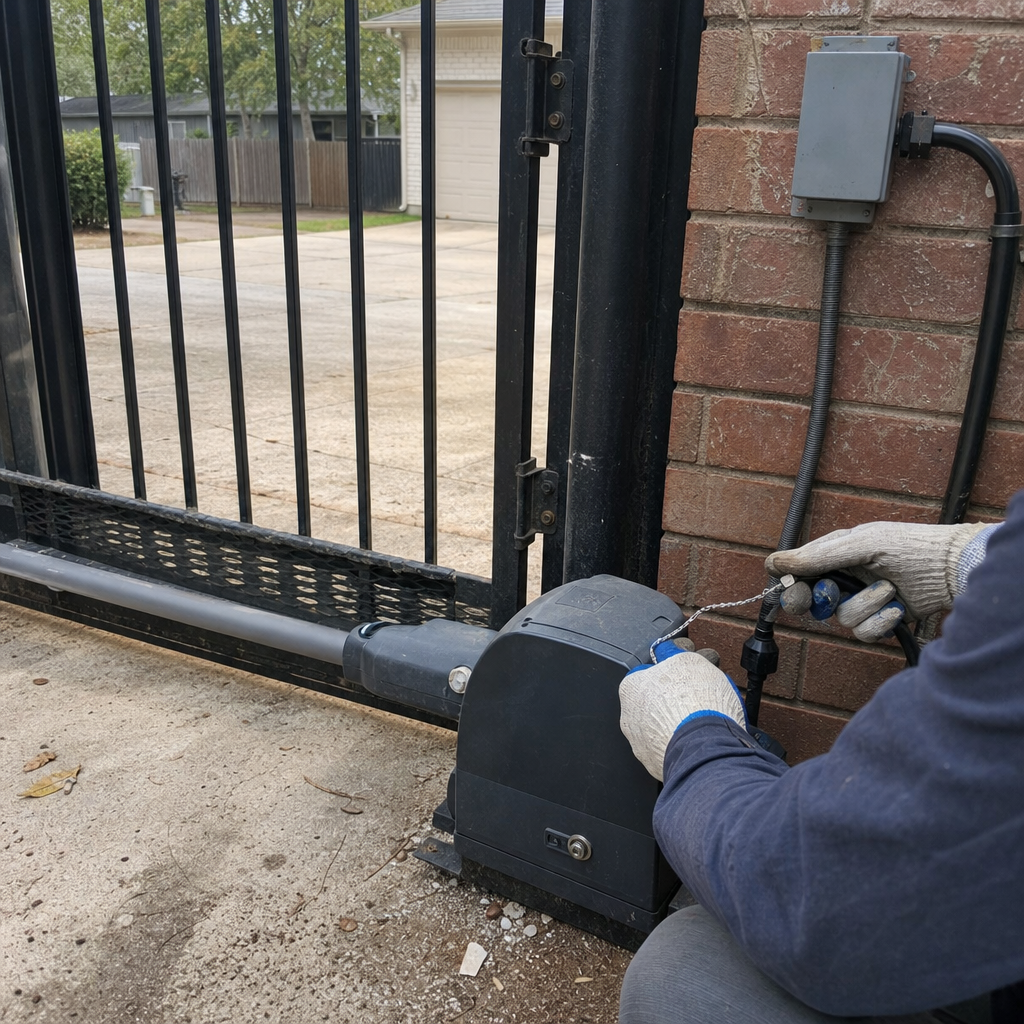
- Motor troubleshooting, gear replacement, or control board programming
- Replacing damaged pickets, slats, or infill panels on an existing gate frame
- Programming remotes, keypads, or intercom systems that use existing low-voltage wiring
In Houston specifically, the Horizon Gate Repair Service Texas home team has noticed that the Public Works Department tends to flag gate work more aggressively when it’s attached to a new fence permit or when the property sits on a corner lot with sidewalk visibility. If you’re replacing a manual gate with an automated one in Houston Heights or the Museum District, expect scrutiny even for residential work — the historic district overlays and pedestrian traffic density trigger additional review.
North Texas cities like North Richland Hills, where gate repair in North Richland Hills is a core part of our service area, often follow the International Building Code with local amendments. We’ve found that Tarrant County suburbs generally require permits for any new operator installation but exempt “repair and replacement in kind” — meaning you can swap a failed Viking or Linear operator for an identical model without a permit, but upgrading from a basic swing gate to a gate motor & opener in North Richland Hills with added access control features will require documentation.
UL 325 Compliance: The Safety Standard That Affects Your Liability
UL 325 is the Underwriters Laboratories standard for door, drapery, gate, louvre, and window operators and systems. For automated gates, it mandates specific entrapment protection: photo eyes, edge sensors, or contact switches that stop and reverse gate motion when an obstruction is detected. This isn’t a suggestion — it’s referenced directly in the National Electrical Code (NEC Article 430) and adopted by reference in most Texas municipal codes.
Here’s where property owners get caught: a gate can function perfectly and still fail UL 325 compliance. We’ve arrived at Houston homes where a previous installer wired a Ghost Controls or Mighty Mule operator without proper entrapment devices, or where a homeowner disabled photo eyes because “they kept triggering in the rain.” Both scenarios create significant liability.
Key UL 325 requirements for automated gates:
- Primary entrapment protection: Photo electric sensors (photo eyes) or equivalent non-contact devices must monitor the gate path and reverse direction within 2 seconds of contact.
- Secondary entrapment protection: For sliding gates, contact sensors or pressure-sensitive edges on the leading edge; for swing gates, similar protection at the pinch point between gate and post.
- Warning signage: Automated gates must display visible signage indicating automatic operation — a detail Houston inspectors check during commercial occupancy inspections.
- Manual release: All operators must include a manual release mechanism for emergency egress, tested and demonstrated to the property owner.
In our experience, Houston’s commercial building inspectors are particularly strict on item #3. We’ve seen restaurants and medical offices in the Galleria area fail final inspection because the installer used generic “Caution” signs instead of the specific “Automatic Gate — Keep Clear” language UL 325 requires. The fix is simple — we carry compliant signage on our trucks — but the delay costs the business days of operational downtime.
From a liability standpoint, non-compliant entrapment protection exposes property owners to premises liability claims. If a delivery driver, child, or pet is injured by a gate lacking required sensors, your insurance carrier may deny coverage if the installation predates UL 325 adoption or was modified without proper safeguards. James Wilson has testified in two such cases over 20 years, and in both instances, the absence of documented compliance became central to the dispute.
Houston Municipal Codes vs. North Texas Requirements
Houston operates under the City of Houston Building Code, which adopts the International Building Code (IBC) 2018 with local amendments. For gates specifically, Chapter 10 (Means of Egress) and Chapter 31 (Special Construction) contain the most relevant provisions. The Houston Fire Department also weighs in on gate placement when it affects emergency access — a consideration that rarely arises in residential contexts but frequently complicates commercial installations near hospital districts or high-occupancy buildings.
Houston-specific factors:
- Floodplain management: Houston’s post-Harvey building code amendments require that new structural posts in 100-year floodplains meet specific elevation and anchoring standards. A gate post in Memorial or near Buffalo Bayou isn’t just a post — it’s a FEMA-reportable structure if it exceeds certain dimensions.
- Historic district review: Properties in Houston Heights, Main Street/Market Square, or Old Sixth Ward require Historic Preservation Review for any visible gate modification, even when no building permit is otherwise required.
- Corner lot visibility: Houston’s traffic engineering division reviews gate placement on corner lots to ensure sight lines for pedestrians and vehicles. We’ve had to relocate planned gate openings by as little as 18 inches to satisfy this requirement in Montrose and Rice Military.
North Texas presents a patchwork. Dallas uses the Dallas Development Code with specific gate provisions for alleys and driveways. Fort Worth references the IBC 2018 with amendments but delegates much gate oversight to the Tarrant County Fire Marshal for commercial properties. Suburbs like North Richland Hills, where gate installation in North Richland Hills is a growing segment of our work, typically follow the International Residential Code for single-family homes but require separate electrical permits for any new 120V operator circuit.
The practical difference: in Houston, you’re more likely to encounter floodplain and historic overlays. In North Texas, electrical permitting is more granular, and HOA architectural committees are often more active in newer master-planned communities. James Wilson has handled permits in both markets since 2006, and the key is knowing which municipality’s portal to check before work begins — not after.
HOA Overlay: When Deed Restrictions Add a Second Approval Layer
Municipal permits and HOA approval are separate processes, and neither satisfies the other. This is the most common point of confusion we encounter in Houston’s master-planned communities — Cinco Ranch, The Woodlands, Sugar Land’s First Colony, and newer developments in Cypress and Katy.
We’ve lost count of how many times a Houston homeowner completed permitted gate work, only to receive a violation notice from their HOA architectural committee because the gate style, height, or material didn’t match community standards. The Katy homeowner from our opening hook? Their six-week closing delay wasn’t caused by the city — it was the HOA’s architectural review board flagging the unpermitted operator as a “structure not approved in original design.”
How Houston-area HOA gate restrictions typically work:
- Pre-application review: Most HOAs require submission of gate specifications, material samples, and sometimes contractor insurance certificates before work begins. This can take 30–45 days in large communities.
- Height and style constraints: Common restrictions include 6-foot maximum height for side-yard gates, prohibition of chain-link or barbed wire, and mandatory color matching to community palettes.
- Operator noise limits: Some Houston HOAs, particularly in dense townhome developments near Midtown and EaDo, restrict operator decibel levels or prohibit certain drive types (chain-driven operators are sometimes banned in favor of belt or screw drive).
- Maintenance obligations: Deed restrictions may require annual professional inspection or mandate specific brands — we’ve encountered communities that require LiftMaster or DoorKing operators for warranty consistency across the development.
Our recommendation: always request the HOA’s architectural guidelines in writing before planning gate work. In Houston’s competitive real estate market, a gate that violates deed restrictions becomes a disclosure issue that can tank a sale or force a costly retrofit. James Wilson has personally replaced gates that were perfectly code-compliant but failed HOA review — work that could have been avoided with a 10-minute phone call to the property manager.
What a Code-Compliant Gate Installation Record Looks Like
When you sell a property in Harris or Tarrant counties, the title company will search for open permits and unpermitted structural work. A clean gate installation record doesn’t just happen — it’s built document by document. After two decades, we’ve learned what survives scrutiny and what creates red flags.
The complete record should include:
- Municipal permit application and approval: The original permit with scope description (“installation of automated swing gate operator with 120V dedicated circuit”), permit number, and final inspection sign-off. In Houston, this is accessible through the city’s PWE Permitting Portal.
- Contractor documentation: Invoice or contract specifying the work performed, contractor name, and date. For Horizon jobs, James Wilson’s name appears on every document — no subcontractor ambiguity.
- UL 325 compliance certificate or manufacturer documentation: Most major brands — Linear, Viking, Ghost Controls, DoorKing — provide compliance documentation with new operators. Request this from your installer and keep it with your home records.
- HOA approval letter: Written confirmation from the architectural committee or property manager approving the specific gate design and operator.
- Maintenance and inspection log: Annual or bi-annual professional service records demonstrate ongoing compliance and can satisfy insurance or HOA renewal requirements.
In Houston’s post-Harvey real estate environment, buyers and their lenders are more cautious about unpermitted work than at any point in the last 20 years. A missing permit for a gate operator installation can trigger a full property inspection, delay closing, or require the seller to obtain retroactive permitting — a process that involves opening walls, exposing electrical work, and paying penalties that dwarf the original installation cost.
We’ve helped Houston homeowners reconstruct gate records from 10 or 15 years prior. It’s always possible, but never convenient. The property owners who keep organized files from day one sail through title review. Those who don’t — like that Katy homeowner — learn an expensive lesson about documentation.
Who Should Pull the Permit: You or Your Contractor?
Texas law allows either the property owner or the contractor to act as permit applicant, but the implications differ significantly. After 20 years of navigating Houston and North Texas permitting offices, James Wilson has strong recommendations based on who bears responsibility when something goes wrong.
When the contractor should pull the permit:
- The work involves electrical, structural, or commercial components where code compliance requires trade-specific knowledge
- The contractor is performing gate installation in North Richland Hills or similar markets where municipal inspectors know established contractors and trust their work
- You want warranty protection that includes permit compliance — if we pull the permit, we guarantee it closes
- The project requires multiple permits (electrical, building, fire) that must be coordinated
When the owner might pull the permit:
- Simple repair or replacement in kind where you’re confident the scope is correctly described
- You’re acting as your own general contractor and coordinating multiple trades
- The municipality offers owner-builder programs with reduced fees
How to verify a contractor’s permit history:
- Request the contractor’s Texas contractor license number (if applicable — not all gate work requires state licensure, but electrical work does)
- Search the municipal permit portal using the contractor’s business name. In Houston, the PWE Permitting Portal allows public search by contractor. In Fort Worth, use the Development and Permitting Center online lookup.
- Check for open or expired permits — a contractor with multiple open permits may have scheduling or financial issues that delay your project.
- Ask for reference properties where similar work was recently permitted and inspected. We routinely provide addresses of recent Houston and North Richland Hills jobs where owners can verify our permit history directly.
The critical point: whoever’s name is on the permit is legally responsible for code compliance. If you pull an owner permit and hire an unqualified installer who botches the electrical, you’re liable for the correction. If we pull the permit as Horizon Gate Repair Service Texas, that responsibility sits with us — and with James Wilson personally, since he’s on every job site.
Common Mistakes to Avoid
- Assuming gate work is “just maintenance”: Replacing a manual gate with an automated operator is installation, not repair, and almost always triggers permitting. We’ve seen Houston homeowners face $500+ penalties for this assumption.
- Ignoring HOA pre-approval: Starting gate work before HOA architectural review completes can result in stop-work orders and fines, even when municipal permits are properly obtained. In The Woodlands, this mistake can cost $200+ per day in violation fees.
- Disabling UL 325 safety devices: Bypassing photo eyes or edge sensors because they’re “too sensitive” voids insurance coverage and creates premises liability. Houston personal injury attorneys specifically look for this in slip-and-fall and gate injury cases.
- Using online permit status as final authority: Municipal portals sometimes lag. Always request a physical or PDF final inspection approval before considering a permit closed. We’ve seen Houston sales delayed because a permit showed “approved” online but lacked the final inspector’s signature in the recorded document.
- Failing to transfer operator documentation at sale: Warranty cards, UL 325 compliance sheets, and remote programming codes should transfer with the property. Buyers who can’t operate or service their gate call us for costly reprogramming that original documentation would have prevented.
- Hiring based on lowest bid without permit verification: Unpermitted work is often cheaper because it skips inspection and compliance costs. The savings evaporate when retroactive permitting, penalties, or failed title review arise. 638 customers and counting have learned that documented, compliant work protects value.
When to Call a Professional
Call a qualified gate technician when your project involves structural posts, new electrical circuits, automated operator installation, or any work in a floodplain, historic district, or HOA-governed community. The cost of professional permitting support is minor compared to the expense of retroactive compliance or failed real estate transactions.
Horizon Gate Repair Service Texas offers free estimates in Houston — call (855) 301-3214. James Wilson personally evaluates each project for permit requirements before work begins, and we handle municipal and HOA documentation as part of our installation and repair services. Whether you need gate repair in North Richland Hills or a complete access control system in Houston, one call covers it: permitting guidance, code-compliant installation, and the documentation you’ll need for resale or insurance claims.
Frequently Asked Questions
Most routine repairs — hinge welding, sensor adjustment, motor troubleshooting, picket replacement — do not require permits in Houston. However, replacing structural posts, installing new electrical circuits, or converting a manual gate to automated operation typically requires a building or electrical permit. Call (855) 301-3214 for a free estimate and we’ll confirm your specific permit requirements before starting work.
Permit fees vary by municipality. Houston’s building permit fees for residential gate work typically range from $85–$250 depending on scope, with electrical permits adding $50–$150. North Texas suburbs like North Richland Hills often charge $75–$200 for similar work. Commercial permits cost substantially more. Your contractor should provide permit cost estimates as part of their bid — we always do.
UL 325 is the safety standard requiring automated gates to have entrapment protection — photo eyes, edge sensors, or contact switches that stop and reverse the gate when obstruction is detected. Non-compliant installations create homeowner liability for injuries and may void insurance coverage. All operators we install from Linear, Viking, Ghost Controls, and DoorKing meet current UL 325 requirements.
Yes, if the work violates deed restrictions or architectural guidelines. Houston-area HOAs can enforce style, height, material, and even brand restrictions that are stricter than city code. Always obtain written HOA approval before starting gate work in a governed community — municipal permits do not override private deed restrictions.
Search your municipality’s online permit portal using your property address. In Houston, use the PWE Permitting Portal. Look for closed permits with final inspection approvals related to fence, gate, or electrical work. If records are unclear or predate digital systems, contact the permit office directly. We help Houston homeowners reconstruct permit histories when needed — call (855) 301-3214 for assistance.
Almost certainly. Title companies in Harris and Tarrant counties routinely flag open or missing permits during pre-sale review. Unpermitted structural or electrical gate work can delay closing, trigger buyer repair demands, or require expensive retroactive permitting. Maintaining documented, code-compliant gate records protects your sale timeline and negotiating position.
The Bottom Line
Gate permits in Texas aren’t about bureaucracy — they’re about protecting property value, limiting liability, and ensuring safety. The work that triggers permitting is structural, electrical, or commercial in nature, while routine mechanical repairs typically proceed without city involvement. UL 325 compliance isn’t optional for automated gates, and Houston-area HOAs add a separate approval layer that catches many property owners by surprise. Keep complete records, verify your contractor’s permit history, and never assume that “just a repair” falls outside regulatory scope. The 20 minutes spent confirming requirements saves weeks of headaches when it’s time to sell, claim insurance, or pass HOA inspection.
Written by James Wilson, Owner & Lead Technician at Horizon Gate Repair Service Texas, serving Houston since 2006.