
Last updated July 6, 2026
The Complete Guide to Gate Repair in Houston
Houston sits on some of the most expansive clay soil in the country — soil that shifts up to 4 inches seasonally, and that movement is quietly destroying gate posts and hinge alignments across the city every year. We’ve pulled posts from River Oaks that leaned 8 degrees off plumb and replaced hinges in The Heights that had sheared clean through from accumulated stress. This guide maps every common gate failure to its real root cause so you stop paying for symptom fixes while the underlying problem keeps coming back. You’ll learn how Houston’s black clay, coastal humidity, and hurricane wind loads uniquely damage gates — and how to tell whether you need a repair, a structural reset, or a complete rebuild.
Quick Answer
Gate repair in Houston typically costs $175–$650 for mechanical fixes and $800–$2,400 for structural post or foundation work, with same-day service available for most operator and access control issues. Most gate failures in Houston trace to three local factors: expansive clay soil shifting posts and misaligning gates, Gulf Coast humidity corroding hardware and electronics, and mismatched replacement parts installed by technicians unfamiliar with your specific brand. James Wilson has diagnosed and repaired these exact failure patterns across Houston for 20 years.
Table of Contents
- How Houston’s Expansive Clay Soil Destroys Gates
- Coastal Humidity: The Hidden Hardware Killer
- Brand-Specific Repair Considerations
- Repair vs. Structural Reset vs. Full Rebuild
- Hurricane-Season Wind Loads and Hardware Choices
- The Houston Gate Repair Priority Matrix
- Common Mistakes to Avoid
- When to Call a Professional
- Frequently Asked Questions
How Houston’s Expansive Clay Soil Destroys Gates
Houston’s black clay gumbo isn’t just difficult to garden in — it’s actively hostile to gate structures. This soil expands when wet and contracts when dry, creating a seasonal pumping motion that slowly loosens concrete footings, tilts posts, and throws precise gate alignments out of spec. We’ve measured post movement of 2–4 inches vertically between March and August on properties from Memorial to Pearland.
Here’s how clay soil damage typically presents:
- Post lean: The gate post tilts toward or away from the opening, often with a visible gap opening between the post base and surrounding concrete. In Houston’s Energy Corridor, we see this most on 6×6 wooden posts set in shallow footings.
- Hinge stress cracking: As the post moves, hinges bind and transfer torque to the gate frame. Steel tube gates develop fatigue cracks at hinge welds; aluminum gates oval out their hinge pin holes.
- Operator misalignment: Swing gate operators like the LiftMaster SL595 or FAAC 402 depend on consistent geometry between the gate leaf and operator arm. A post that shifts 1.5 inches can put enough side-load on the operator to trigger fault codes or burn out the motor.
- Latch failure: The receiving post shifts while the gate leaf stays put — or vice versa — and the latch no longer meets its strike plate.
Diagnosis in three steps:
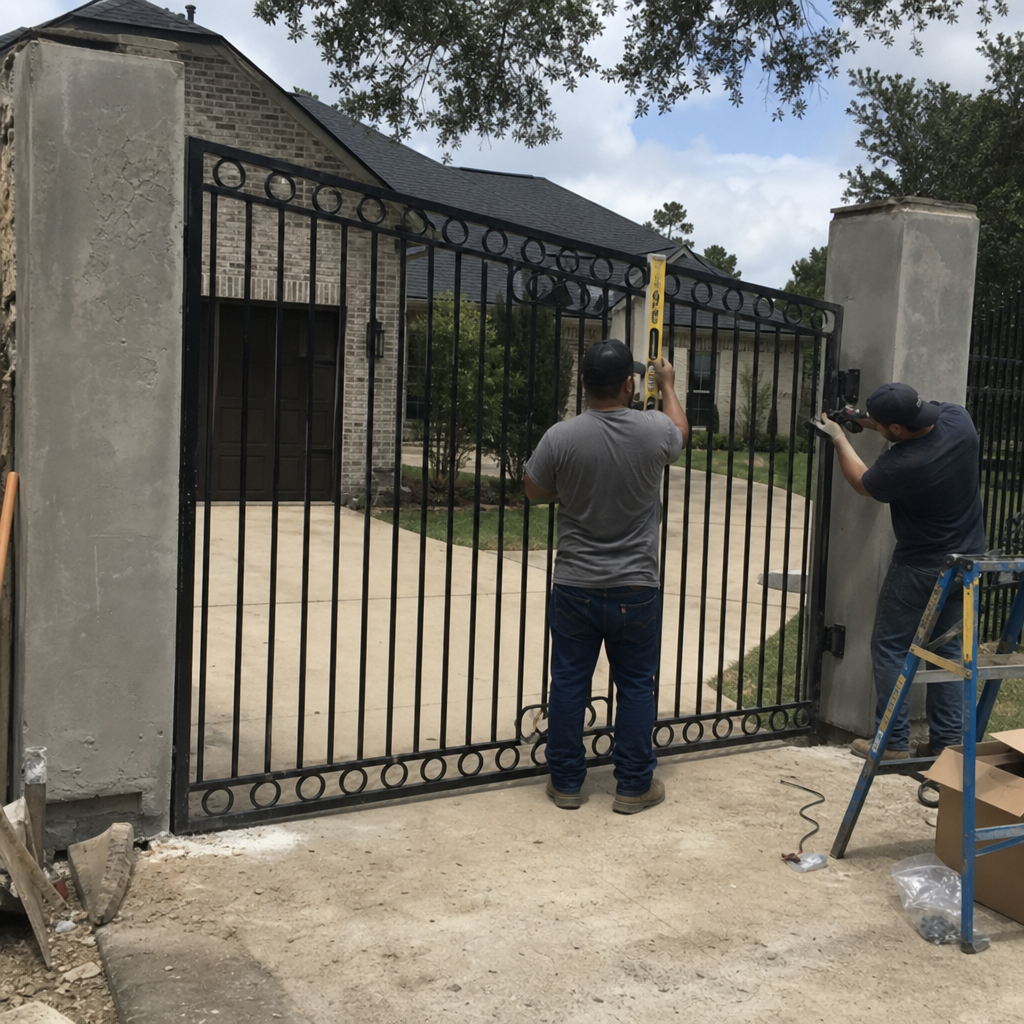
- Plumb check: Hold a 4-foot level against the post. In Houston, we consider anything past 2 degrees off plumb a warning sign; past 4 degrees, and you’re looking at foundation work, not just hinge adjustment.
- Seasonal comparison: Does the gate operate smoothly after dry spells but bind after heavy rain? That’s the clay expanding and contracting — a structural issue, not a lubrication problem.
- Footing inspection: Look for concrete collar separation, soil cracking in a radius around the post, or water pooling at the base. Any of these indicate the footing is moving independently of the surrounding soil.
We’ve reset posts in Bellaire that had been “repaired” three times with new hinges — the handyman never checked if the post itself was plumb. The homeowner spent $900 on hinge and operator repairs that failed again within eight months. James Wilson has handled this personally for 20 years, and the pattern is always the same: fix the foundation first, or keep paying for the same symptoms.
Coastal Humidity: The Hidden Hardware Killer
Houston averages 75% relative humidity year-round, with summer mornings regularly hitting 90%+. That moisture doesn’t just make you uncomfortable — it infiltrates gate control boxes, condenses inside operator housings, and accelerates galvanic corrosion between dissimilar metals. We’ve opened control boxes in Clear Lake that had standing water on the circuit board and replaced hinge pins in Sugar Land that had lost 30% of their cross-section to rust.
The damage patterns are specific and predictable:
- Printed circuit board failure: Gate operators from Mighty Mule, LiftMaster, and FAAC all use PCBs with conformal coating, but that coating degrades after 5–7 years in Houston’s humidity. We see intermittent operation — gate works fine at noon, dead at 6 AM when condensation peaks — that gets misdiagnosed as a wiring issue.
- Galvanic corrosion at stainless-aluminum interfaces: Houston’s salty Gulf air accelerates the electrochemical reaction between stainless steel fasteners and aluminum gate frames. The aluminum always loses. We find this most on coastal-facing properties in League City and Galveston County.
- Limit switch drift: Mechanical limit switches in humid environments develop contact oxidation. The gate “forgets” where open and closed positions are, leading to partial opening, hard stops, or reversing unexpectedly.
- Keypad and intercom degradation: Access control keypads with rubber membrane buttons trap moisture underneath. Buttons become intermittent, then fail completely. PIN pads in unshaded locations fail fastest.
Prevention and repair approach:
For existing systems, we desiccant-treat control boxes during service calls and upgrade ventilation where possible. For new installations in Houston, we specify marine-grade hardware and separated metal interfaces — never direct stainless-to-aluminum contact without a dielectric barrier. We stock parts and weld on-site, so when we find corrosion-damaged hinge pins or gate catches, we fabricate replacements rather than waiting on third-party vendors.
One note on safety: gate operators store significant energy in their springs or counterbalance systems, and control boards carry lethal voltage even when disconnected from mains. We don’t recommend homeowners open operator housings for inspection. James Wilson has handled this personally for 20 years, and we’ve seen the aftermath of well-intentioned DIY voltage checks.
Brand-Specific Repair Considerations
Not all gate operators fail the same way, and not all technicians are equipped to diagnose across brands. Horizon Gate Repair Service Texas services nine major manufacturers — LiftMaster, FAAC, BFT, Linear, Viking, Ghost Controls, DoorKing, Elite, and Mighty Mule — because we’ve learned that brand fluency saves our Houston customers from unnecessary replacements and incompatible parts.
Here’s what distinguishes the most common systems we encounter:
LiftMaster SL595 (swing gate, residential/light commercial):
The SL595 uses a worm-gear drive that’s sensitive to side-loading from post movement. In Houston, we see the worm gear strip when clay-soil post shift puts lateral force on the operator arm. The fault code flashes indicate motor overload, but the root cause is structural. A generalist replaces the motor; we diagnose the post, fix the geometry, and save the original operator. LiftMaster parts are widely available, but the SL595’s encoder board requires proprietary calibration — not a generic swap.
FAAC 402 (hydraulic swing gate):
FAAC’s hydraulic systems are robust against Houston humidity because the motor and electronics are sealed separately from the hydraulic circuit. The failure point is the hydraulic fluid itself — heat cycling in Houston’s 100°F summers degrades the fluid and causes valve sticking. We flush and refill with FAAC-spec fluid, not generic hydraulic oil. The 402 also has a mechanical bypass for manual operation that seizes if unused; we exercise it during every service call.
Mighty Mule FM500 (DIY-friendly swing gate):
The FM500 is common in Houston’s suburban developments because it’s priced for homeowner installation. The control board is the weak point in humid climates — we’ve replaced dozens in Cypress and Katy that failed within 3–4 years. The aftermarket replacement boards often lack the same conformal coating. We service your brand with OEM-spec parts, and when an FM500 is beyond economical repair, we can discuss upgrade paths to more robust systems.
BFT (Italian hydraulic and electromechanical):
BFT systems use a different limit-switch architecture than American brands — magnetic sensors rather than mechanical cams. In Houston’s humidity, the sensor connectors oxidize and give false limit readings. Cleaning the connectors with proper contact cleaner (not WD-40) usually resolves it. BFT’s diagnostic LED sequence is also different from LiftMaster or FAAC patterns; misreading it leads to replacing the wrong component.
The key point: a technician who only knows one brand’s fault codes will guess on the others. We service your brand because James Wilson has spent 20 years building fluency across all nine manufacturers. One call covers it — no referrals elsewhere.
Repair vs. Structural Reset vs. Full Rebuild
This is where Houston gate owners lose the most money to misdiagnosis. A gate that won’t close smoothly could need a $45 hinge pin, a $1,200 post reset with new concrete footing, or a $4,500 complete replacement — and the symptoms look nearly identical from the driveway. Here’s how we distinguish them.
Repair (mechanical only):
Appropriate when the post is plumb, the footing is stable, and the failure is isolated to a component. Examples: worn hinge pin, failed limit switch, dead keypad, stripped operator gear. Typical range in Houston: $175–$650. We stock parts and weld on-site, so most repairs complete in one visit.
Structural reset:
Required when the post has shifted but the gate frame and operator are still serviceable. We excavate the existing footing, pour a new pier to 36–48 inches depth (below Houston’s active clay zone), and re-plumb the post. The gate and operator are reinstalled with adjusted geometry. Typical range: $800–$2,400 depending on post size, gate weight, and access. This is the option most handymen skip — they’ll sell you new hinges twice a year rather than fix the footing once.
Full rebuild:
Indicated when the gate frame itself is twisted (common on welded steel tube gates after years of operating on a shifted post), when multiple components are at end-of-life, or when the original installation was fundamentally underspecified for the gate’s weight or wind exposure. Typical range: $2,800–$7,500+ for residential; commercial systems higher.
Our decision framework:
- Plumb and level the post. If it’s out of spec, stop — no mechanical repair will last.
- Inspect the gate frame for twist or rack. A twisted frame will never operate smoothly regardless of new hinges or operators.
- Test the operator under load. If it strains or faults with a properly aligned gate, the operator may be undersized or worn internally.
- Check all components for concurrent wear. If hinges, latch, operator, and keypad are all 15+ years old, sequential repairs become false economy.
In Houston’s Memorial area, we recently evaluated a 14-foot iron gate that had been “repaired” four times in three years. The post was 6 degrees off plumb and the frame had twisted 2 inches out of square. The owner had spent $2,100 on symptom fixes. We reset the post, straightened the frame with on-site welding, and reinstalled the existing operator with corrected geometry. Total cost: $1,850. The gate has operated without issue for 18 months since. 638 customers and counting have taught us that honest diagnosis saves money, even when it means recommending the more expensive fix upfront.
Hurricane-Season Wind Loads and Hardware Choices
Houston’s hurricane exposure isn’t just about the named storm — it’s about the 40–60 mph wind events that happen a dozen times per season, each one loading your gate as a sail and testing every connection. We’ve replaced gates after Ike, Harvey, and Nicholas, and the failure patterns are consistent enough to plan for.
Wind load basics for Houston gates:
A solid-panel gate (privacy wood, ornamental iron with minimal scrollwork) presents roughly 20–25 psf of wind load at 60 mph. A 16-foot double swing gate = 32 square feet of area = 640–800 pounds of force trying to tear it off its hinges or pull the post from the ground. Slatted or open-design gates reduce this by 40–60%, which is why we often recommend them for Houston’s wind-exposed properties.
Hardware specifications that matter:
- Hinge capacity: Residential-grade hinges are rated for the gate’s dead load only. In Houston, we specify hinges with 3x safety factor for wind load — a 400-pound gate gets hinges rated for 1,200 pounds dynamic load. We fabricate heavy-duty hinge brackets on-site when standard hardware is insufficient.
- Post sizing: A 12-foot iron gate on a 4×4 post is underbuilt for Houston. We use 6×6 minimum for wood, 4×4×1/4 wall steel tube minimum for metal, with footings sized for lateral wind load, not just vertical dead load.
- Operator hold-force: Swing gate operators have adjustable electronic hold-force settings. We calibrate these for Houston’s wind patterns — too loose, and the gate bangs in gusts; too tight, and the operator strains, overheats, or fails to reverse on obstruction.
- Sliding gate wind resistance: Sliding gates are inherently more wind-stable because they’re supported along their length, but the track and roller system must be rated for lateral load. We’ve replaced bent track in Katy after wind events that a properly specified system would have survived.
For properties in coastal Houston zip codes — 77573, 77581, 77584, 77598 and similar — we also specify 316-grade stainless hardware rather than 304, for the additional salt-air corrosion resistance. The upfront cost difference is 15–20%; the replacement cost after five years of 304-grade failure is 100%.
The Houston Gate Repair Priority Matrix
Not every gate problem needs same-day attention, but some absolutely do. This matrix reflects 20 years of Houston service calls and the safety risks we’ve encountered.
| Issue | Priority | Timeline | Rationale |
|---|---|---|---|
| Gate stuck open, property unsecured | Immediate | Same day | Security exposure; liability if unauthorized entry occurs |
| Gate stuck closed, vehicle trapped | Immediate | Same day | Emergency vehicle access; fire code egress requirement |
| Operator reverses unexpectedly on closing | Urgent | 24–48 hours | Safety sensor or limit failure; crush hazard risk |
| Noisy operation, grinding, or jerking | Scheduled | 1–2 weeks | Progressive wear; address before cascade failure |
| Cosmetic rust or finish degradation | Monitor | Next scheduled service | Aesthetic; monitor for structural section loss |
| Remote intermittent, keypad slow | Scheduled | 1–2 weeks | Convenience; often battery or antenna issue |
| Post lean <2 degrees, gate still operates | Monitor/Plan | Within 6 months | Clay soil movement; will worsen, plan structural reset |
| Post lean >4 degrees | Urgent | 1–2 weeks | Structural failure in progress; operator and gate damage imminent |
The most expensive mistake we see in Houston is delaying a “scheduled” priority until it becomes “immediate.” A grinding hinge that costs $180 to replace becomes a $900 operator rebuild when the misalignment burns out the motor. We stock parts and weld on-site specifically to compress these timelines — most scheduled repairs in our Houston service area complete within 72 hours of contact.
Common Mistakes to Avoid
- Ignoring seasonal patterns: Houston gate owners who notice problems only after rainstorms are seeing clay soil expansion, not random mechanical failure. Treating this as a lubrication issue with WD-40 on the hinges wastes money and masks the real problem.
- Using generic replacement parts: A LiftMaster operator needs LiftMaster-spec limit switches; a FAAC hydraulic system needs FAAC fluid. Cross-brand parts often fit physically but fail electronically or chemically within months.
- Hiring handymen for operator diagnostics: General handymen can replace a hinge, but gate operator fault codes require brand-specific knowledge. We’ve been called to Houston properties where the previous “technician” replaced three circuit boards when the issue was a $12 transformer.
- Neglecting the manual release: Every gate operator has a manual release for power outages. Houston’s hurricane season makes this critical. If you don’t know where yours is or it hasn’t been tested in a year, you’re one grid failure from being trapped or exposed.
- Matching new operators to old gates without load calculation: A heavier replacement gate — common when Houston homeowners upgrade from chain-link to ornamental iron — needs operator recalculation. We’ve seen new operators burn out in six months because they were specified for the previous gate’s weight.
- Skipping foundation inspection after any repair: If your technician fixes the hinge but doesn’t plumb the post, the new hinge will fail on the same timeline as the old one. Always verify post stability before accepting mechanical repairs as complete.
- Assuming all stainless steel is equal: In Houston’s humid, salt-exposed environment, 304-grade stainless corrodes visibly within 3–5 years. 316-grade lasts 15+ in the same conditions. The price difference is recoverable in the first avoided replacement cycle.
When to Call a Professional
Call a gate specialist rather than attempting DIY when you encounter: electrical faults in the operator or control box; structural post movement or concrete footing damage; any gate that reverses unpredictably or fails to reverse on obstruction (safety system failure); welding or fabrication needs for frame cracks or hinge bracket replacement; or brand-specific diagnostics where fault codes aren’t translating to obvious component failure.
Horizon Gate Repair Service Texas offers free estimates in Houston — call (855) 301-3214. James Wilson serves as lead technician on every job, so the expertise you discuss on the phone is the expertise that arrives at your property. We service your brand, we stock parts and weld on-site, and we’ve built our reputation on diagnosing root causes rather than selling recurring symptom fixes. Gate Repair in North Richland Hills and surrounding areas are also within our service region.
Frequently Asked Questions
Mechanical repairs like hinge replacement, operator adjustment, or keypad replacement typically run $175–$650 in the Houston market. Structural work — post reset, footing replacement, or frame straightening — ranges $800–$2,400. Full gate replacement with new operator starts around $2,800. Call (855) 301-3214 for an exact quote — estimates are free.
Houston’s expansive clay soil swells when wet (typically winter and spring) and shrinks when dry (summer). That seasonal movement shifts your gate posts by 1–4 inches, binding hinges and throwing off operator alignment. The gate isn’t “settling in” — the foundation is moving. A plumb check and possible structural reset will solve it permanently.
We service nine major manufacturers: LiftMaster, FAAC, BFT, Linear, Viking, Ghost Controls, DoorKing, Elite, and Mighty Mule. James Wilson has brand-specific diagnostic training and stocks common parts for all nine, so almost no system requires a referral elsewhere.
Repair is cheaper when the post is stable, the frame is square, and the failure is isolated to one or two components. Replacement becomes more economical when the frame is twisted, multiple systems are at end-of-life, or the original installation was undersized for the gate’s weight or wind exposure. We evaluate all three factors before recommending; 638 customers and counting have taught us that honest assessment builds lasting relationships.
Same-day service is available for gates stuck open or closed, safety system failures, and other security-critical issues. For scheduled repairs, we typically arrive within 72 hours. We stock parts and weld on-site, so most repairs complete in a single visit.
Most residential gate repairs — mechanical component replacement, operator swap, hinge repair — do not require permitting. Structural post replacement or new gate installation may trigger Houston building department review, particularly if the gate exceeds 6 feet in height or is part of a pool enclosure. We advise on permit requirements during our free estimate and can coordinate documentation when needed.
The Bottom Line
Houston gate failures demand Houston-specific diagnosis. The black clay soil, Gulf humidity, and hurricane wind exposure here create failure patterns that generic repair advice misses entirely. Before you accept a hinge replacement or operator swap, verify your post is plumb, your frame is square, and your technician understands your specific brand’s diagnostic language. The complete guide to gate repair in Houston comes down to this: fix the foundation that the soil is moving, protect the electronics that the humidity is attacking, and match the parts to the brand that built your system. Do that, and you’ll escape the cycle of recurring repairs that costs Houston property owners thousands. Gate Installation in North Richland Hills and Gate Motor & Opener in North Richland Hills services are available through our expanded service area as well.
Ready to stop treating symptoms? Call Horizon Gate Repair Service Texas at (855) 301-3214 for a free estimate. James Wilson will assess your gate personally, diagnose the root cause, and give you a straight answer on whether you need a repair, a structural reset, or a full rebuild — no pressure, no upsell, just 20 years of Houston gate experience applied to your specific situation.
Written by James Wilson, Owner & Lead Technician at Horizon Gate Repair Service Texas, serving Houston since 2006.