

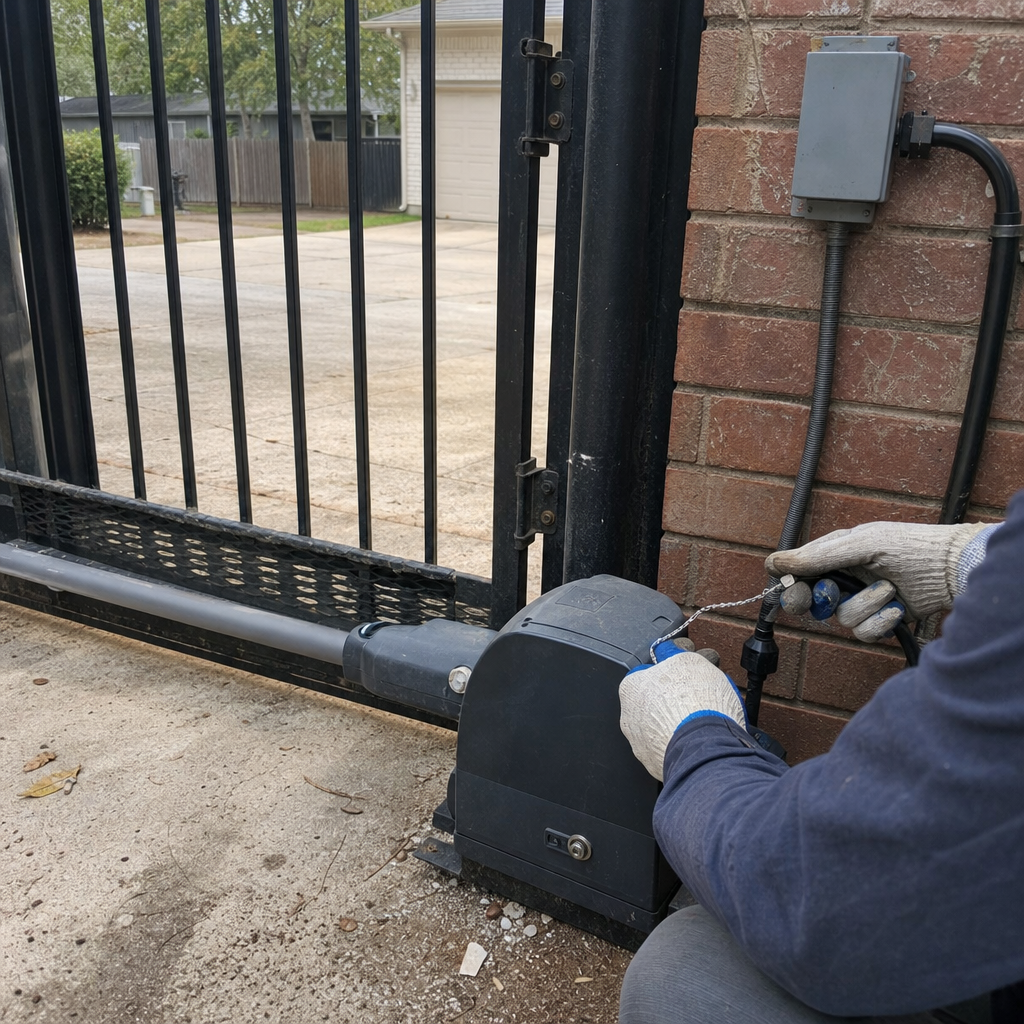
Fast, Reliable Gate Installation Across Fort Worth
Gate installation in Fort Worth typically runs $2,800–$7,500 for a standard residential automated gate, with most projects completed in 2–4 days once permits are approved. We serve Fort Worth from our Houston base, with dedicated scheduling that puts us on-site across Tarrant County within 24–48 hours for most installations. Whether you’re replacing a sagging 1960s ranch gate in the 76107 zip code or automating a new livestock panel entry off Chisholm Trail Parkway in 76108, our Gate Installation team handles the full scope—footings, fabrication, operator mounting, and safety compliance.

James Wilson has spent 20 years installing gates in Texas clay soil, and Fort Worth’s Fort Worth Prairie geology presents challenges that generic installers from outside the region routinely underestimate. The expansive Blackland-type clay here swells after spring thunderstorms and cracks open during August droughts, heaving posts out of plumb within a season if footings aren’t deep enough. We’ve learned that the hard way—so you don’t have to. Call (855) 301-3214 for a free estimate.
Why Horizon Gate Repair Service Texas Is Fort Worth’s Preferred Gate Installation Company
We’ve earned 638 verified customer reviews averaging 4.8 stars, and a growing share of those come from Fort Worth homeowners who found us after watching another company install a gate that sagged within 18 months. James Wilson serves as lead technician on every job—no rotating subcontractors, no phone tag with someone who’s never seen your property.
Our familiarity with Fort Worth’s specific conditions sets us apart. We know the 1950s–1970s ranch homes on the west side (76107–76109) commonly have single ornamental iron driveway gates mounted to brick or native limestone columns, where mortar joints crack as clay soil shifts. We know the master-planned subdivisions along Chisholm Trail Parkway and the Alliance corridor require HOA-mandated automated gates meeting UL 325 standards under Tarrant County permit rules. And we know the 76108 corridor still holds active horse properties inside city limits—meaning we regularly install working livestock panel gates alongside standard residential work, a combination few gate companies in major Texas cities can handle.
We stock parts for LiftMaster, FAAC, BFT, Linear, and other major brands, and we weld on-site. That means fewer return trips, faster completion, and gates that actually stay square through Fort Worth’s seasonal soil cycles.
Our Gate Installation Services in Fort Worth
Swing Gate Installation
Swing gates remain the dominant style across Fort Worth’s older neighborhoods, and they’re where we see the most failed installations by competitors. The 1950s–1970s ranch homes in 76107 and 76108 often have existing brick or limestone columns with nonstandard hinge placement—old iron gates were hung wherever the masonry allowed, not to modern specs. We custom-fabricate retrofit brackets or weld new hinge plates directly to reinforced columns, then pour footings at least 42 inches deep to beat clay soil heave. For a recent installation near Camp Bowie Boulevard, we reinforced a crumbling 1960s column with embedded steel angle and mounted a Linear swing operator rated for the gate’s actual weight—not the undersized unit the previous installer had used.
Security Gate Installation
Fort Worth’s western transition into horse-property zoning creates unique security demands. In the 76108 corridor off Chisholm Trail Parkway, we installed a heavy tubular steel security gate on a horse property where the original one-piece iron gate had sheared its bottom hinge due to decades of clay soil heave. We had to pour a new concrete pier 4 feet deep to beat the soil movement, then mount a FAAC hydraulic swing operator to handle the weight and meet local UL 325 safety standards. Security gates here need to stop vehicles without stopping livestock, handle sustained plains winds that Dallas-area gates don’t face, and survive soil that moves inches per season. We engineer for all three.
Sliding Gate Installation
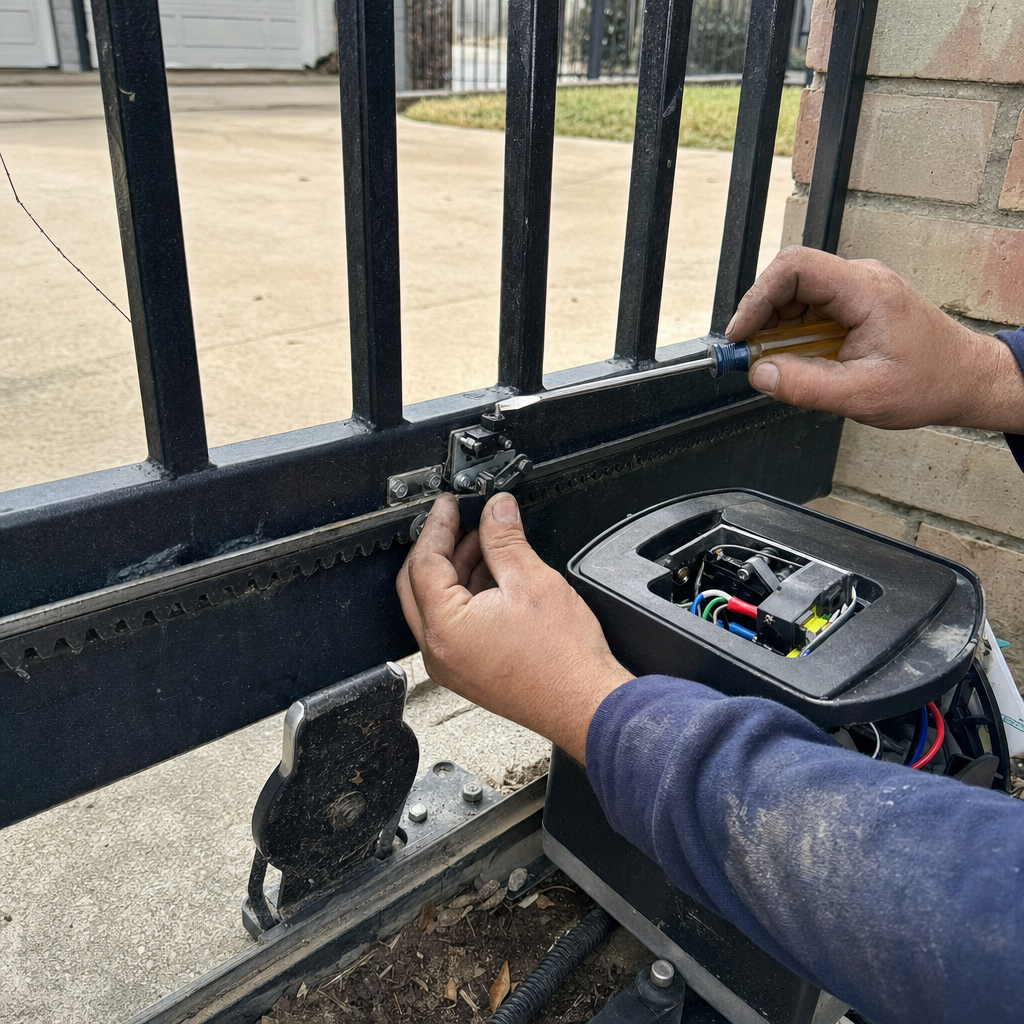
Sliding gates suit Fort Worth properties with steep driveways, limited swing clearance, or wide openings where a single swing gate would catch too much wind. The newer master-planned communities along Alliance corridor often specify sliding gates for aesthetic consistency at neighborhood entrances. We install cantilever and track-mounted systems, with critical attention to foundation depth—sliding gates concentrate lateral loads on a single post, and shallow footings in Fort Worth clay guarantee callback within two years. Our sliding gate installations include proper drainage around the track pad to prevent the washout that ruins alignment after Texas downpours.
Pedestrian Gate Installation
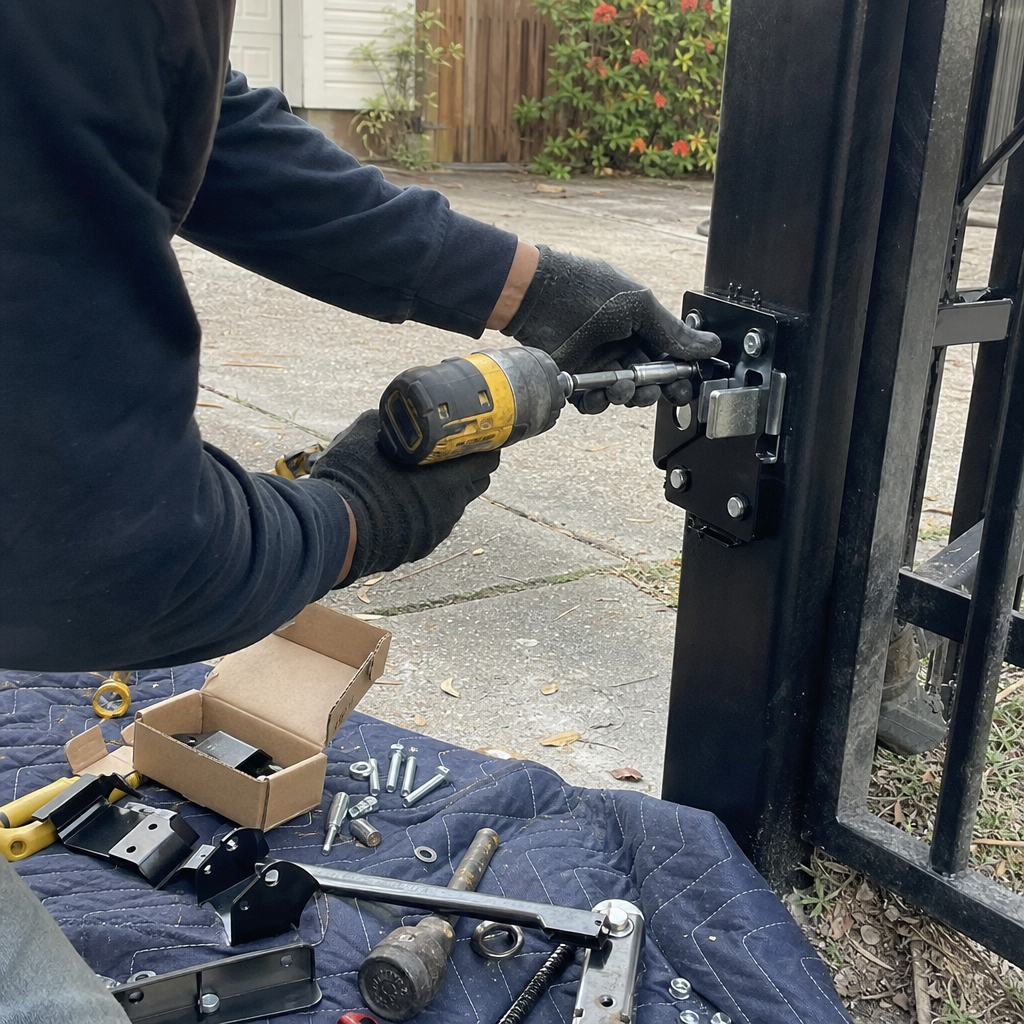
Pedestrian gates in Fort Worth serve a specific role: separating backyard pools from alley access, securing side yards in 76107’s dense ranch neighborhoods, or providing walk-through access alongside automated driveway gates. We match pedestrian gates to existing ironwork—wrought-iron picket styles for historic neighborhoods, tubular steel for modern installations—and ensure latch hardware clears Fort Worth’s shifting ground planes. A pedestrian gate that latches cleanly in March may drag by August if hinge posts aren’t set below the clay’s active zone. We set them deep, with adjustable hinges for seasonal fine-tuning.
Double Gate Installation
Double gates split the swing load across two panels, reducing stress on individual posts and operators. They’re common on wider Fort Worth driveways, especially in the 76108 horse properties where equipment access requires 16-foot or greater openings. Double gates demand precise center-stop alignment—any gap or overlap worsens as posts heave. We install adjustable center stops and heavy-duty drop rods that still operate smoothly even when seasonal soil movement shifts the meeting point by half an inch.
What happens when you call
- 1
A real person answersNo phone trees — you reach a local pro.
- 2
You get an upfront price rangeHonest numbers before anyone is dispatched.
- 3
A background-checked tech heads outLicensed & insured, dispatched right away.
- 4
You approve before work beginsNothing starts until you say go.
Trusted Brands We Service in Fort Worth
We service and stock parts for nine major gate brands, including LiftMaster, FAAC, BFT, and Linear. For Fort Worth customers, this brand fluency means we rarely need to refer you elsewhere. When your HOA specifies a particular operator for neighborhood consistency, when your existing system needs matching hardware, or when you’re choosing new equipment for a fresh installation, we can source, install, and warranty the right unit from day one. Our on-site welding capability covers custom mounting brackets for nonstandard applications—critical for Fort Worth’s legacy installations where modern operators don’t bolt to 1960s hinge patterns without adaptation.
Common Gate Installation Problems We See in Fort Worth Homes
- Clay soil heave twists gate posts out of alignment within two years if footings aren’t at least 42 inches deep. Fort Worth’s Fort Worth Prairie expansive clay swells and contracts dramatically with moisture changes. We’ve replaced dozens of competitor installations where 24-inch footings seemed adequate in dry summer soil, only to heave and tilt after the first wet spring.
- Mortar joints in brick and limestone columns crack from soil movement, causing hinge brackets to pull loose. The 1950s–1970s ranch homes across 76107–76109 are particularly vulnerable. We assess column integrity before hanging new gates and reinforce or rebuild as needed—often pouring new steel-reinforced piers inside deteriorated masonry shells.
- Old 1950s–70s iron gates have nonstandard hinge placement, requiring custom welding or retrofit brackets. These gates weren’t manufactured to modern specs; they were hand-fitted on-site. Replacing them with stock gates from big-box retailers leaves ugly gaps, misaligned latches, and stress points that fail early. We measure, fabricate, and weld for exact fit.
- Sustained plains winds accelerate hinge and latch wear on wide ranch-style gates. Fort Worth catches more wind than Dallas due to less terrain buffering. Wide single-panel gates act as sails, stressing hardware beyond residential ratings. We specify heavier-duty hinges and wind-load-rated operators for exposed properties.
Pricing for Gate Installation in Fort Worth, TX
| Gate Type | Typical Range in Fort Worth | What’s Included |
|---|---|---|
| Single swing gate (manual, ornamental iron) | $2,800–$4,200 | Gate, posts, basic hardware, standard footing depth |
| Single swing gate (automated) | $4,500–$6,800 | Gate, operator, safety devices, 42-inch footings, UL 325 compliance |
| Double swing gate (automated) | $6,200–$9,500 | Two gates, dual operators or single with transmitter, center stop, enhanced footings |
| Sliding gate (automated) | $5,800–$8,900 | Gate, track/cantilever system, operator, safety loop, drainage pad |
| Security/livestock panel gate (heavy tubular steel) | $7,200–$12,000 | Heavy-gate fabrication, deep pier (48+ inches), hydraulic operator, safety systems |
| Pedestrian gate (standalone) | $1,400–$2,600 | Gate, posts, latch hardware, standard footings |
| Column reinforcement or rebuild | $800–$2,400 | Demolition, steel reinforcement, concrete pier, veneer repair |
These Fort Worth ranges reflect actual material and labor costs for our market, including the deeper footings and structural reinforcement that clay soil demands. HOA-mandated specifications, custom ironwork, access control integration, and Tarrant County permit fees may add to project totals. We provide itemized, upfront quotes—no vague estimates that balloon once we’re on-site. Call (855) 301-3214 for your free estimate.
We Also Serve Cities Near Fort Worth
We regularly install gates in Haltom City, River Oaks, Forest Hill, and Saginaw—communities that share Fort Worth’s clay soil challenges and often the same Tarrant County permit requirements. If you’re in these areas, the same expertise and response times apply.
Serving Fort Worth, TX — Our Local Coverage Area
We’re based in the Fort Worth area and know this community well. Use the map below to see our service coverage — if you’re nearby, we can almost certainly help.
FAQs — Gate Installation in Fort Worth
Usually yes, but it depends on the column’s internal condition. We often pour a new steel-reinforced concrete pier inside the existing brick or limestone shell, then mount new hinge brackets to that solid core—saving the original masonry appearance while giving the gate a foundation that won’t shift. In about 30% of cases we see in 76107, the column is too deteriorated internally and requires partial rebuild. We’ll assess on-site and give you both options with exact costs. Call (855) 301-3214 for a free evaluation.
Yes—we specialize in exactly this combination, which is nearly unique to Fort Worth among major Texas cities. We can install automated swing gates for vehicle access with adjacent manual sliding arena gates, or full automation on both depending on your workflow. The livestock panel hardware we use is heavy tubular steel rated for animal impact, paired with operators sized for actual gate weight—not residential units overstressed by agricultural-duty gates. We also ensure cattle gaps and adjacent fencing integrate cleanly with the gate system.
Minimum 42 inches deep for residential gates in Fort Worth’s expansive clay, and 48 inches or more for heavy security or livestock gates. This gets below the soil’s active moisture zone, where seasonal swelling and shrinking occur. Shallower footings—24 or 30 inches—are common in other regions but fail here within one to two wet-dry cycles. We also use wider pier bases and steel reinforcement to resist the lateral pressure that clay exerts when saturated. Call (855) 301-3214 and we’ll evaluate your specific soil conditions and gate load.
Repair is rarely cost-effective for sagging one-piece iron gates in Fort Worth. The sag usually indicates structural fatigue—either the gate frame has twisted from years of wind load and soil movement, or the hinge post has tilted beyond adjustment. Straightening and re-hanging typically costs $600–$1,200 but lasts only until the next soil cycle. A new gate with proper deep footings and modern hardware runs $2,800–$4,200 for manual, $4,500–$6,800 automated, and solves the underlying geometry and foundation issues. We quote both approaches honestly; most Fort Worth homeowners choose replacement after seeing the numbers. Call (855) 301-3214 for exact pricing on your gate.
Yes—automated gates in unincorporated Tarrant County and most Fort Worth jurisdictions require permits that verify UL 325 safety compliance, proper entrapment protection, and electrical work inspection. We handle permit application and inspection scheduling as part of our installation process. The typical timeline adds 3–5 business days before work begins, and permit fees generally run $150–$400 depending on jurisdiction and gate type. We know the specific requirements for Fort Worth, Forest Hill, and Saginaw jurisdictions and ensure your installation passes inspection the first time. Call (855) 301-3214 to confirm permit needs for your exact address.
Written by James Wilson, Owner at Horizon Gate Repair Service Texas, serving Fort Worth and the greater Houston area since 2004.