
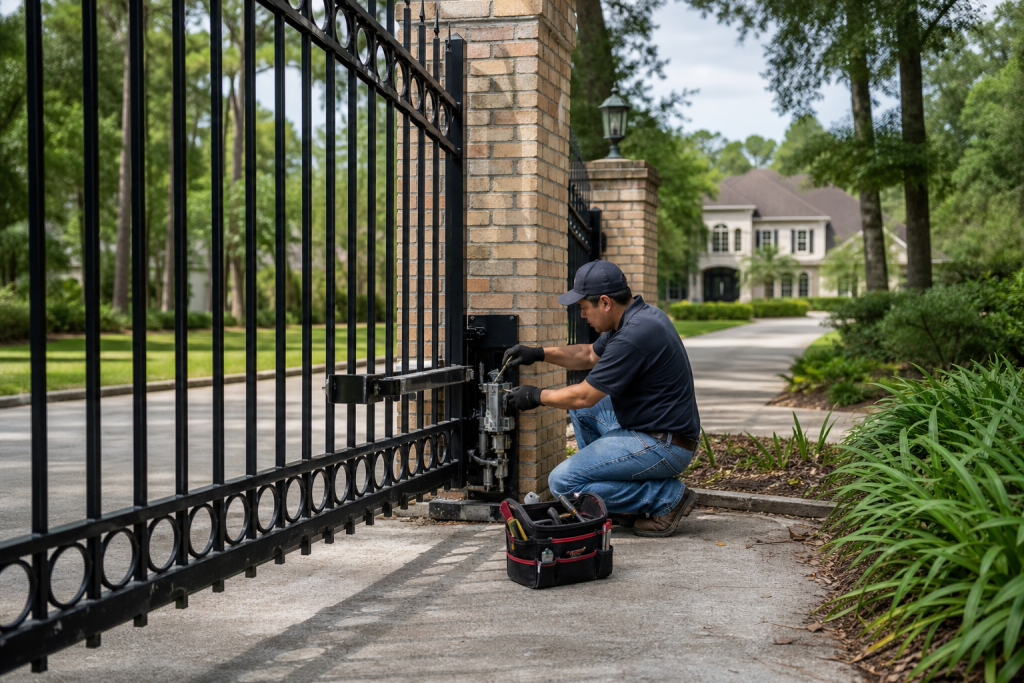
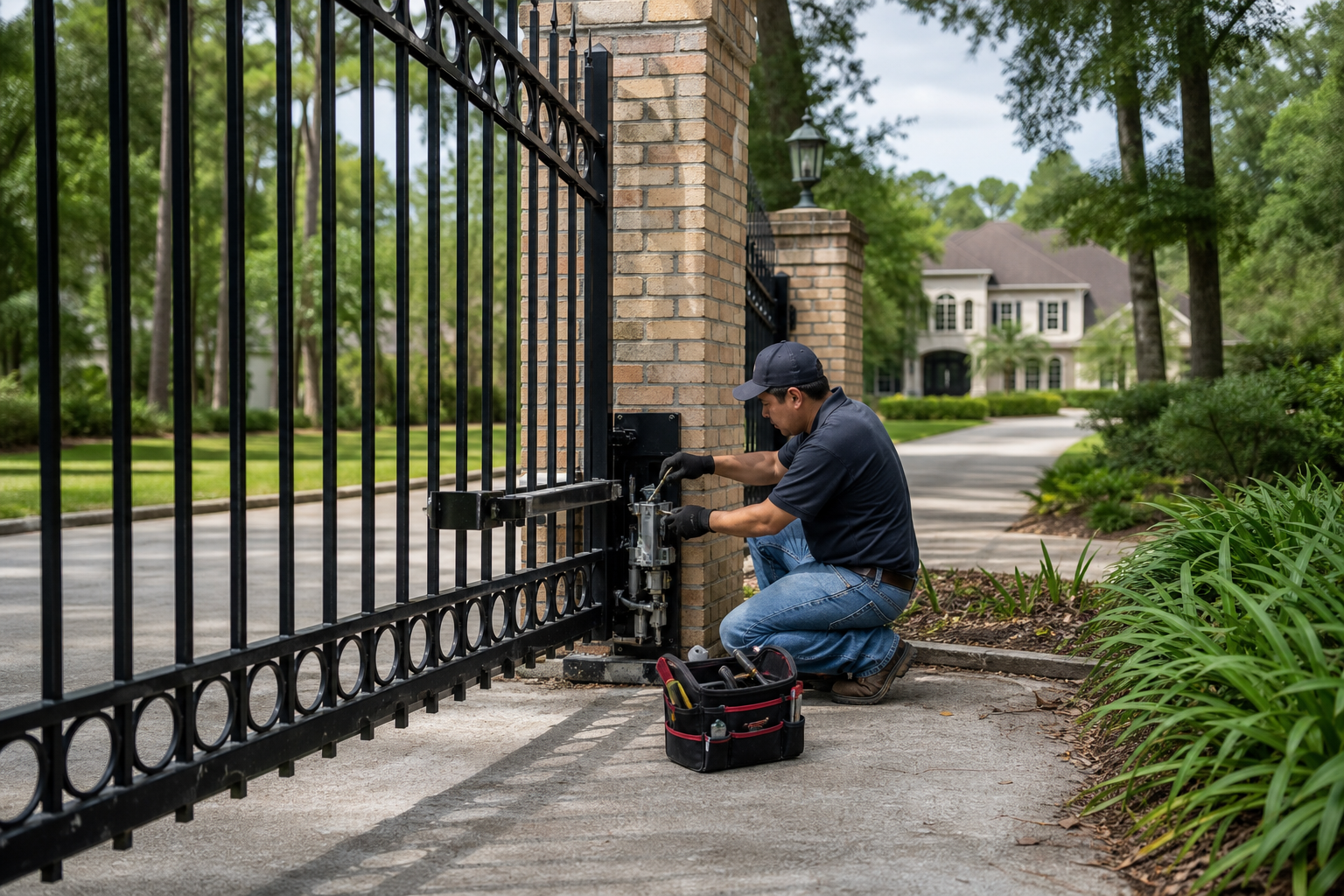
Mighty Mule Gate Repair in Houston: A Homeowner’s Guide
Mighty Mule gate repair in Houston typically runs $180–$420 depending on whether you’re dealing with a dead battery, a failed control board, or structural arm bracket fatigue. Most same-day repairs fall in the $180–$280 range. If you’d rather not diagnose it yourself, call us at (855) 301-3214 — we stock Mighty Mule parts and can usually sort it out in one visit.
Here’s the thing about Mighty Mule systems in Houston: the FM500 battery is the single most replaced component we see, and about seven out of ten times, that battery died because a sprinkler head has been firing directly at the operator box for three seasons running. The control board sits in a vented housing that isn’t sealed against Gulf Coast humidity, and Houston’s combination of afternoon thunderstorms, clay soil that shifts with moisture, and UV exposure creates failure patterns that generic repair guides completely miss. We’ve been sorting these out since 2006, and the same five problems show up again and again — just rarely the same way twice.
How Houston’s Climate Destroys Mighty Mule Systems (And Why Most Guides Get It Wrong)
Mighty Mule markets these as DIY-friendly systems, and they are — in Phoenix or Denver. Houston’s climate introduces three variables that the installation manual barely acknowledges: sustained humidity above 75% for six months of the year, clay soil that expands and contracts dramatically, and UV intensity that degrades plastics faster than the national average.
We pulled a system out of a garage over in Memorial last month where the homeowner had replaced the battery twice in fourteen months. The real culprit wasn’t the battery at all — the solar panel’s UV-degraded film had dropped output to 40%, so the battery was constantly cycling deep. A new battery kept dying because it was never getting a full charge. That’s a $180 solar panel fix, not a $45 battery ritual every spring.
The five failure modes we see in Houston, in order of frequency:
- Battery drain from humidity intrusion — Vented housings let moist air condense on the control board, creating micro-shorts that pull phantom load even when the gate isn’t cycling.
- Arm bracket fatigue on heavy wooden gates — Houston homeowners love cedar and ipe gates; Mighty Mule’s standard arm brackets are rated for lighter aluminum, and the clay-soil shifting adds torsional stress.
- Solar panel output loss from UV film degradation — After 3–4 Houston summers, output drops below the threshold to maintain charge on a gate that cycles 8–12 times daily.
- Limit switch drift from gate post movement — Clay expansion/contraction tilts posts by fractions of an inch, but that’s enough to throw the magnetic or mechanical limit switches out of calibration.
- Receiver board corrosion — The remote receiver sits in the same humid housing as the control board, and oxidized traces cause intermittent response that looks like a remote battery problem.
Generic troubleshooting tells you to “check the battery and remote.” In Houston, that’s maybe 30% of the actual root causes.
Diagnosing a Mighty Mule That “Just Stopped Working”: The Decision Tree
When a Houston homeowner calls and says their Mighty Mule “just stopped working,” we’ve got about ninety seconds of questions that separate a $35 fix from a $180 board replacement. Here’s the sequence we run through:
Step one: Listen for the click. When you hit the remote, does the control board click at all? No click usually means power isn’t reaching the board — battery, fuse, or transformer. A click with no movement means the board’s output stage is firing but the motor or arm isn’t responding.
Step two: Check the LED pattern. Mighty Mule boards flash specific codes. A steady red versus a flashing red versus no light at all point to three different diagnostic paths. The manual covers this, but Houston humidity can make the LED itself unreliable — corrosion on the indicator leads can show “no light” when the board is actually fine.
Step three: Test under mechanical load. Disconnect the arm and try to cycle the motor. If it runs free but stalls connected, you’ve got a mechanical binding issue — often the arm bracket starting to fatigue, or the gate post having shifted in our clay soil. If it won’t run even unloaded, you’re looking at motor or board.
Step four: Voltage at the battery terminals under load. A battery can show 12.4 volts at rest and drop to 8 volts the moment the motor draws. That’s a classic sulfated battery, and in Houston, it’s usually from chronic undercharging (see solar panel note above) rather than simple age.
The mistake we see most: homeowners replace the battery, get two months of function, and assume they got a bad battery. They’re treating a symptom. We’ve probably diagnosed three hundred of these over the years, and the real root cause is almost always upstream.
Which Mighty Mule Models Survive Houston (And Which Don’t)
Mighty Mule makes a wide range, and Houston’s market tends to install undersized systems because the price jump to the next model feels steep at purchase. Here’s what we’ve learned from two decades of seeing which ones come back for repair:
The MM560 and MM660 series handle Houston residential duty reasonably well if the gate is aluminum or light steel under 16 feet and 550 pounds. The 24V DC motor runs cooler than the 12V systems, and cooler operation means less condensation cycling inside the housing when our humidity spikes.
The FM500 and FM502 are where we see the most trouble. They’re rated for gates up to 18 feet and 850 pounds, but that rating assumes ideal conditions — level mounting, stable posts, moderate climate. In Houston, with our clay soil and heavy wooden gates, we consider them realistically suited for 14-foot aluminum gates or 12-foot wood. Push past that and you’re looking at arm bracket fatigue in 18–24 months.
The MM-LPS13 and commercial-grade MM-SL2000B are better matches for Houston’s heavier residential gates, but they’re rarely installed because the homeowner didn’t know the weight of their gate when they bought the opener. We’ve weighed gates in River Oaks that the owner thought were “maybe 400 pounds” that scaled out at 780. That mismatch kills systems.
If you’re shopping now: weigh your gate, add 20% for Houston’s wind load, and buy the next model up from what the chart suggests. The upfront cost difference is usually $120–$180. A single service call for an undersized system runs $200–$280.
OEM vs. Aftermarket Parts: Where the Savings Are Real
We stock both OEM Mighty Mule parts and quality aftermarket alternatives, and we’re direct about where each makes sense. Aftermarket batteries? Fine, if they’re AGM construction and match the Ah rating — we’ve had good results with Universal Power Group and ExpertPower units that run $35–$45 versus $55–$65 OEM. The savings are real and the performance is equivalent.
Aftermarket control boards? That’s where we push back. We’ve seen three different third-party boards for the FM500 that list compatibility but lack the humidity conformal coating that Mighty Mule applies to OEM boards. In Houston’s climate, that coating isn’t optional — it’s the difference between a board that lasts five years and one that corrodes in nine months. We tried saving customers money on these twice. Both times, we were back within a year replacing the replacement. We don’t offer them anymore.
Arm brackets and mechanical hardware: aftermarket is usually fine if it’s galvanized or stainless. The OEM brackets are powder-coated steel that holds up well; we’ve had equal luck with marine-grade stainless aftermarket units that actually outlast the original in our humidity.
The rule we give Houston homeowners: electrical components that live in the housing — stick with OEM. Mechanical components that live outside — aftermarket quality is acceptable and the savings are genuine.
When Your Mighty Mule Has Reached Its Economic Repair Life
There’s a point where repairing a Mighty Mule becomes throwing good money after bad, and we’re upfront about that threshold. Here’s our honest calculus:
Repair makes sense when: The system is under 8 years old, the gate itself is in good condition, and the repair is a single component — battery, arm bracket, limit switch, or solar panel. Total repair under $280, with expected 3–5 year additional life.
Replace makes sense when: The control board has failed and the system is over 6 years old (board + labor runs $280–$420, and other components are likely near end of life); the motor is drawing excessive amperage (indicates winding degradation — $340–$480 repair versus $520–$780 new system); or you’ve already done two repairs in three years.
Upgrade path: For Houston homeowners who want to stay in the DIY-friendly price range but need better durability, we often recommend Horizon Gate Repair Service Texas home consultations to compare the Mighty Mule MM-SL2000B against commercial-grade alternatives like FAAC or Linear operators. The jump to a FAAC 422 or Linear PRO Access system runs $1,200–$1,800 installed versus $680–$920 for a premium Mighty Mule — but the commercial units carry 5–7 year lifespans in Houston conditions, versus 3–5 for the Mighty Mule. Over ten years, the math often favors the upgrade.
We don’t push upgrades for the margin. We’ve got no brand exclusivity — we service nine major manufacturers, including BFT and Viking, so our recommendation goes where the durability math points. James Wilson has handled these evaluations personally for 20 years, and our 638 customers and counting keep us honest.
When to Call a Pro (And What We’ll Check)
If you’ve run through the click-test and LED check and you’re still stuck, or if you’re not comfortable working around a charged battery and a gate that could move unexpectedly, we’re a phone call away. We’ll verify voltage under load, check your solar panel output with a proper meter, and inspect the arm bracket for micro-cracks that aren’t visible until the arm is under tension — that’s not a flashlight-and-mirror diagnosis.
Related services in Houston: Gate Repair in North Richland Hills, Gate Installation in North Richland Hills, and Gate Motor & Opener in North Richland Hills.
The Bottom Line
Mighty Mule systems can serve Houston homeowners well, but only if you match the model to your actual gate weight, protect the control housing from direct sprinkler exposure, and replace the solar panel before UV degradation takes it below functional output. Most “mysterious” failures aren’t mysterious — they’re predictable consequences of Houston’s humidity, clay soil, and UV intensity interacting with a system designed for milder climates.
Key takeaways:
- The FM500 battery dies most often from chronic undercharging, not age — check solar output first.
- Arm bracket fatigue is a model-mismatch problem, not a defect — buy for your actual gate weight plus 20%.
- OEM control boards matter in Houston; aftermarket electricals fail faster without conformal coating.
- Two repairs in three years means you’re near replacement territory — we’ll tell you straight.
- Direct sprinkler contact with the operator box is the single most preventable cause of early failure.
If you’re in Houston and your Mighty Mule is acting up, Horizon Gate Repair Service Texas offers free estimates — call (855) 301-3214. James Wilson will handle the diagnosis personally, we stock parts and weld on-site, and we’ll give you the honest repair-versus-replace math even if it means a smaller invoice today.
Frequently Asked Questions
Most same-day Mighty Mule repairs in Houston run $180–$280, with simple battery or limit switch replacements at the lower end and control board or motor replacements toward $340–$420. Solar panel replacement typically falls at $160–$220. We don’t charge diagnostic fees if you proceed with the repair. Call (855) 301-3214 for an exact quote — estimates are free.
Chronic battery death almost always traces to insufficient charging, not bad batteries. In Houston, check three things: solar panel output (UV film degrades to 40% in 3–4 years), transformer voltage if you’re on AC power, and whether the control board has humidity-induced micro-shorts pulling phantom load. We’ve seen homeowners replace four batteries before finding the real cause — usually a $35 fuse or $180 solar panel, not another battery.
Yes, and for heavy gates in Houston’s climate, it’s often the better long-term value. The mounting footprint differs, so expect some bracket fabrication — that’s where our on-site welding capability matters. A commercial-grade FAAC or Linear system runs $1,200–$1,800 installed versus $680–$920 for a premium Mighty Mule, but the service life in Houston conditions typically doubles. We service your brand either way and can walk through the numbers on-site.
Weigh your gate with a bathroom scale under the trailing edge, then multiply by 1.2 for Houston wind load. If that number exceeds 80% of your opener’s rated capacity, you’re undersized. Common mistake: cedar and ipe gates run 35–50% heavier than aluminum of the same dimensions. We’ve weighed “standard” 16-foot wooden gates at 720+ pounds — well beyond what an FM500 can handle long-term. One call covers it if you want us to verify the match.
Written by James Wilson, Owner & Lead Technician at Horizon Gate Repair Service Texas, serving Houston since 2006.
Need Gate Repair Help?
Call Horizon Gate Repair Service Texas — licensed & insured, here with fast after-hours help in Texas.
(855) 301-3214